

More than 1 in 4 U.S. adults — approximately 70 million people — report at least one functional disability, and that number climbs as the population ages. By 2030, the U.S. Census projects 73.1 million Americans will be 65 or older. Laundry accessibility isn't a niche concern; it's a daily reality for tens of millions of households.
This guide covers the equipment choices, layout benchmarks, and practical home adaptations that make laundry more manageable — whether you're a wheelchair user, someone recovering from surgery, or managing a chronic condition that limits your energy and strength.
Key Takeaways
- Front-loading washers on pedestals bring drum openings and controls to accessible heights for wheelchair users and those with limited mobility
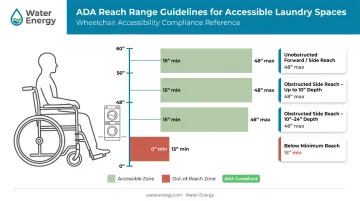
- ADA design benchmarks require at least 30" × 48" of clear floor space in front of each appliance, with controls between 15" and 48" above the floor
- Roll-under folding stations, wheeled laundry carts, and ceiling-mounted hanging rods can dramatically improve independence without major renovation
- Ozone laundry systems like Water Energy's Storm cut chemical use by up to 75%, reducing handling demands for users with chemical sensitivities or limited grip strength
Why Accessible Laundry Matters
For most people, laundry is an afterthought. For someone using a wheelchair or managing a fatigue condition, it can be one of the most physically demanding tasks in the home — and a direct test of how independently they can live.
A 2023 analysis found that 25.4% of community-dwelling adults age 65+ experienced difficulty with instrumental activities of daily living, which include household tasks like laundry. That's not a small subset — it represents millions of older adults whose ability to maintain independence at home depends partly on whether their laundry setup works for them.
The consequences of an inaccessible laundry room extend beyond inconvenience:
- Lost autonomy: Relying on paid help or family members to handle laundry reduces independence and increases household costs.
- Safety risks: For people recovering from surgery or managing arthritis, a poorly designed space means doing the task unsafely — or not at all.
- Chronic condition burden: Conditions like multiple sclerosis and Parkinson's make standard washers and dryers genuinely unmanageable without thoughtful setup changes.
Good accessible design solves for the specific physical demands of the task — reach, grip, posture, and fatigue — so people can manage laundry without assistance.
Choosing the Right Washer and Dryer for Accessible Laundry
Equipment choice is the foundation of accessible laundry. The wrong machine configuration makes every other adaptation harder.
Front-Loading vs. Top-Loading
Front-loading washers are the clear choice for accessible laundry. The 2010 ADA Standards, Section 611.4 require the bottom of a front-loading washer or dryer opening to sit between 15" and 36" above the finished floor — a range that accommodates seated users and those with limited reach. Top-loaders require reaching down into a deep drum, which creates problems for wheelchair users and anyone with shoulder or back limitations.
Front-loaders also position their controls on a forward-facing panel rather than a recessed top surface, making them usable without leaning or reaching overhead.
The Case for Pedestals
Placing a front-loading machine on a pedestal (typically 12" to 15" tall) raises the drum opening to a more ergonomically comfortable position and reduces the need to bend down to load and unload. LG's WDP4 pedestal sits at 13.6"; Whirlpool's WFP2715 is 15.5". Many include built-in storage drawers, which keeps detergent at a reachable height rather than stored on a shelf above or below the machine.
One important caution: raising a machine on a pedestal can also raise its controls, potentially pushing them above the reach range of a seated user. Always check the full appliance-plus-pedestal configuration against reach range requirements before purchasing.
Control Interface Requirements
Per ADA Section 309.4, controls must be:
- Operable with one hand
- Usable without tight grasping, pinching, or wrist twisting
- Activatable with no more than 5 lbf of force
Look for large, clearly labeled push-button or touchscreen controls. Avoid machines with small rotary knobs that require a firm grip.
Skip the Stacked Configuration
Stacked washer-dryer units are convenient for small spaces but problematic for accessibility. The upper unit's controls and drum opening frequently exceed comfortable reach ranges for seated or shorter users. Side-by-side placement is the recommended configuration for accessible appliances, allowing clear floor space to be positioned in front of each unit independently.
Reducing Chemical Handling Demands
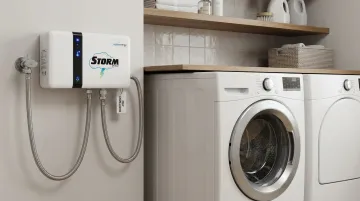
For households managing chemical sensitivities or limited energy (common among people with chronic illness or disability), the physical burden of handling detergent, bleach, and fabric softener adds up. Water Energy's Storm ozone laundry system connects to any existing washer and cuts chemical use by 70% or more, with many users reporting they need little to no detergent at all.
Its maintenance-free, automatic operation requires nothing to add, replace, or adjust, which significantly reduces physical interaction demands. The system is hypoallergenic, with customers reporting fewer skin reactions after eliminating chemical residues from their laundry.
ADA Clearance and Layout Requirements for Home Laundry Spaces
The ADA design benchmarks below apply to covered facilities and multifamily housing, not private single-family homes as a legal mandate. However, they represent well-researched, evidence-based standards that are equally useful as design targets for any home renovation.
Floor Space and Approach
The core requirement: a minimum of 30" wide × 48" deep of unobstructed floor space, centered in front of each accessible appliance. This allows a wheelchair user to position for a parallel approach — meaning the clear space runs alongside the machine, not necessarily directly in front of it. In practice, this affects how machines are positioned in an alcove or closet, since the approach corridor needs to remain unobstructed.
Door and Pathway Clearance
- Laundry room doors: 32" minimum clear width (measured with the door open 90 degrees)
- Bifold or closet doors must not overlap the required clear floor space when open
- Pathways should have smooth, firm surfaces with no thresholds or obstacles
Reach Range Requirements
| Situation | High Reach Maximum |
|---|---|
| Unobstructed forward or side reach | 48" |
| Obstructed side reach (up to 10" depth) | 48" |
| Obstructed side reach (10"–24" depth) | 46" maximum |
| Low reach minimum (all configurations) | 15" |
This matters when specifying where controls, lint screens, and detergent compartments sit. A top-loader with an obstructed side reach deeper than 10" has a lower maximum height than most people assume.
Folding and Sink Surfaces
If your laundry space includes a folding table or utility sink, the work surface should be 28" to 34" above the floor, with knee clearance underneath:
- At least 27" high
- At least 30" wide
- At least 11" deep at the 9" height level (maximum depth: 25")
This lets a wheelchair user roll underneath to fold or sort while seated.
Practical Home Adaptations to Make Laundry Easier
Many of the most effective accessibility improvements require no structural renovation. Some cost under $50; others are a moderate investment — but none require calling a contractor.
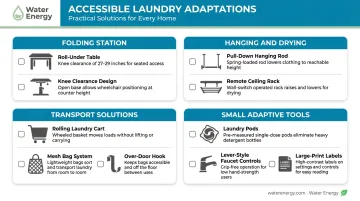
Roll-Under Folding Station
A counter with open knee clearance underneath — either custom-built or an adjustable folding table — allows wheelchair users or anyone who needs to sit while working to fold and sort laundry comfortably. Adjustable-height folding tables from brands like Lifetime are available for roughly $50–$250, with models that adjust to 24", 29", or 36" heights. Verify knee clearance dimensions (width, depth, and any crossbar placement) before purchasing, since not all adjustable tables meet ADA knee-clearance specifications.
Hanging and Drying Solutions
For air-drying clothes, two practical options work well:
- Pull-down closet rods (such as Rev-A-Shelf's CPDR series, which adjusts from 34" to 50") bring hanging height into a reachable range without requiring the user to stretch overhead
- Remote-controlled ceiling drying racks (such as the Foxydry Air, listed around $600) lower and raise via remote control, eliminating reach requirements entirely
A long-handled garment hook — available inexpensively online — lets users hang items on a standard rod without stretching.
Wheeled Laundry Transport
Rolling hampers and laundry carts eliminate the need to carry heavy loads between rooms. Good options include:
- Rolling laundry carts with a handle bar — easy to push for wheelchair users or anyone with limited upper-body strength
- Lightweight mesh laundry bags — reduce sorting effort and move easily from room to room
- Over-door hamper hooks — keep bags accessible at a reachable height without floor bending
Small Adaptive Tools That Make a Real Difference
- Laundry pods — Pre-measured, no pouring or measuring required. Store safely away from children; note they can't be adjusted for load size.
- Lever-style faucet handles on utility sinks are far easier to operate than knobs for users with arthritis or limited grip
- High-contrast, large-print machine labels help users with low vision operate controls independently
- Brightly labeled detergent storage at reachable heights reduces searching and reaching
Reducing the Physical Burden: Smarter Laundry Solutions
Smart Appliance Features
App-based controls from brands like GE (SmartHQ) and Samsung (SmartThings) let people with mobility limitations time their trips to the laundry room rather than making repeated check-in visits. Key features that reduce unnecessary movement include:
- Remote start — initiate a cycle from anywhere in the home
- Cycle monitoring — check progress without walking to the machine
- End-of-cycle notifications — phone alerts when the load is done
- Vibration alerts — especially useful for users with hearing limitations
Note that remote start typically requires the washer door to be closed and smart controls enabled at the machine — loading and unloading still require physical presence.
The Role of Seating
A 2019 rehabilitation study found that standing requires significantly more energy than sitting and specifically recommended seated positioning for folding laundry and ironing. A sturdy bench or chair with armrests placed near the machines gives people with chronic illness, fatigue conditions, or post-surgical limitations the option to sit while working — without having to find and drag over a chair each time.
Reducing Chemical and Thermal Intensity
Reducing chemical and thermal intensity isn't just an environmental choice — it directly cuts the physical demands of laundry. Water Energy's Storm system achieves this by injecting dissolved ozone directly into the wash water, allowing most loads to be cleaned in cold water with minimal detergent.
Chemical residues cling to fabric fibers and cause them to retain moisture — clothes washed with fewer chemicals dry faster. Shorter drying times result from "no chemical residues to hold on to water," which means fewer trips to the dryer and less time spent on the full cycle for anyone managing limited energy.
For the roughly 12.8% of U.S. adults with medically diagnosed multiple chemical sensitivity — and a further 25.9% who report self-described chemical sensitivity — reducing detergent and eliminating fabric softener isn't a preference, it's a health need. The Storm's hypoallergenic design is built for exactly this: its CE RoHS certification confirms the unit itself is manufactured without hazardous substances.
Frequently Asked Questions
How do you do laundry when you have a disability?
Use front-loading machines on pedestals to bring the drum opening to a reachable height, a wheeled laundry cart instead of carrying baskets, a roll-under folding station for seated sorting, and laundry pods to eliminate pouring and measuring. Ozone-based systems like Water Energy's Storm further reduce physical handling by cutting detergent use dramatically.
What is the ADA clearance in front of a washer and dryer?
ADA standards specify a minimum of 30" wide × 48" deep of unobstructed clear floor space, centered on each appliance for a parallel approach. Open doors (including bifold closet doors) must not overlap this space. These apply as legal requirements in covered multifamily and commercial facilities and serve as reliable design targets for private homes.
What type of washer is easiest to use for someone with limited mobility?
Front-loading washers are the most accessible option: the drum opening sits between 15" and 36" above the floor, controls face forward, and users don't need to reach deep into a basin. Raising a front-loader on a 12"–15" pedestal improves ergonomics further, though verify the combined height doesn't push controls out of seated reach.
Can I make my existing laundry room more accessible without a full renovation?
Yes, and most improvements are low-cost and non-structural. Adding a pedestal under an existing front-loader, placing an adjustable folding table with knee clearance underneath, switching to a wheeled laundry cart, and using laundry pods instead of liquid detergent can all make a significant practical difference without touching walls or plumbing.
Are there laundry products easier to handle for people with limited grip strength?
Single-dose laundry pods remove the need to lift, open, or pour from large bottles. Ozone-based systems like the Storm go further: many users report washing with little to no detergent, eliminating chemical handling almost entirely. For utility sinks, lever-style faucet handles are far more manageable than round knobs for anyone with arthritis or reduced hand strength.