This article explains the science behind why workout clothes hold onto odor after washing, walks through a step-by-step fix that addresses the root cause, covers the mistakes that make things worse, and shows how to prevent it long-term.
Key Takeaways
- Sweat is odorless — bacteria metabolizing sweat and body oils on synthetic fibers produces the smell
- Synthetic fabrics like polyester and nylon trap bacteria differently than cotton, making standard washing less effective
- A vinegar pre-soak plus cold-water gentle wash resolves persistent odor in most cases
- Fabric softener and excess detergent make the problem significantly worse over time
- Chronic odor that survives repeated washing requires eliminating bacteria at the source — which is where ozone-based laundry systems deliver
Why Workout Clothes Still Smell After Washing
Sweat itself has no odor. The smell is produced when bacteria on your skin — primarily Staphylococcus epidermidis and Corynebacterium species — metabolize sweat and body oils into volatile compounds like free fatty acids. Research published in PMC identified these bacterial species as the primary drivers of body odor, working on proteins and lipids in apocrine sweat as their substrate.
That bacteria-laden residue embeds itself in fabric fibers. When your body warms the fabric up during your next workout, adsorbed odorants release back into the air. The smell isn't new — it's what the fabric held onto through the wash cycle.
Synthetic Fabrics Trap Bacteria Differently Than Cotton
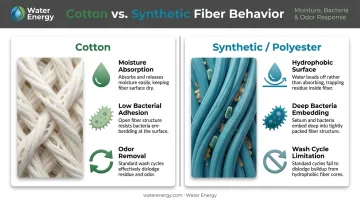
Moisture-wicking fabrics (polyester, nylon, spandex) are engineered to pull sweat away from skin and onto the fabric surface. That same mechanism also pulls body oils and bacteria deep into the fiber structure. In a 26-person cycling study, polyester garments developed significantly stronger, more unpleasant odor than cotton after exercise, with Micrococcus bacteria occurring predominantly on synthetic fabrics.
The reason comes down to chemistry. Polyester is hydrophobic, which increases bacterial adhesion and sebum absorption. Unlike cotton — which absorbs and releases relatively easily — synthetics hold bacterial residue in a way that standard cold or warm wash cycles often can't dislodge.
Detergent and Fabric Softener Residue
Two laundry habits make odor retention significantly worse in synthetic activewear:
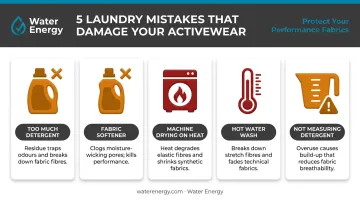
- Too much detergent leaves a film on fibers that doesn't fully rinse out, locking bacteria in before the rinse cycle can remove it. Nike explicitly recommends using less detergent on workout clothing than on regular laundry.
- Fabric softener is worse. Both Nike and lululemon warn against it on performance fabrics. Nike describes the residue as acting "like glue for odor-causing substances." A 2021 textile study confirmed that softener chemistry significantly degrades moisture-management performance in polyester blends.
The more washes with softener, the more entrenched the problem becomes.
A Dirty Washing Machine Can Recontaminate Clean Clothes
A 2023 study sampling 50 building washing machines found fungi in 82% of machines, with the inner rubber door seal accounting for 37.5% of contamination sites. Every pair of sterile socks washed in contaminated machines acquired fungi. A separate 2022 study found post-wash bacterial counts ranging from 10⁴ to 10⁷ CFU per washcloth after washing in cold water with detergent — including Staphylococcus aureus and Pseudomonas aeruginosa.
If your machine is contaminated, your clothes come out of the wash carrying new bacteria, not just whatever they went in with.
Storage Before Washing Makes It Worse
Leaving damp workout clothes sealed in a gym bag creates warm, moist, low-oxygen conditions — ideal for rapid bacterial growth. By the time those clothes reach the machine, the bacterial load is significantly higher than if you'd aired them out first. This isn't a minor detail. It's often why some garments smell worse than others despite identical washing routines.
How to Fix Smelly Workout Clothes: Step-by-Step
The fix has to address embedded bacteria in synthetic fibers — not just mask the smell. Skipping steps is why odors keep returning.
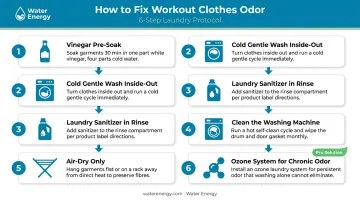
Step 1: Pre-Soak in a Vinegar Solution
Mix one part distilled white vinegar with three to four parts cold water in a basin. Submerge the workout clothes and soak for 30 minutes — up to an hour for garments with severe or repeated odor buildup. Nike's own activewear care guidance recommends this exact pre-soak approach for retained odor.
The mild acidity of standard distilled white vinegar (5% acetic acid) helps loosen bacterial residue and body oil deposits bonded to synthetic fibers before the machine wash. This is not a sterilization step — it's a preparation step that makes the subsequent wash significantly more effective.
Step 2: Wash Correctly — Every Element Matters
The correct technique:
- Turn clothes inside out — the interior surface has the highest bacteria contact and needs direct water and detergent exposure
- Wash in cold water on a gentle or synthetic-specific cycle
- Use no more than two teaspoons of a liquid detergent formulated for activewear or performance fabrics
- Do not add fabric softener at any point
Cold water protects fiber integrity. The gentle cycle prevents agitation damage to elastane and polyester structures. Measured detergent prevents the residue buildup that compounds odor over repeated washes.
Step 3: Add a Laundry Sanitizer for Persistent Cases
For clothes that still carry odor after repeated washing, regular detergent in cold water is often insufficient on its own. A non-chlorine laundry sanitizer added to the final rinse cycle kills remaining bacteria without damaging synthetic fibers. The EPA registration for quaternary ammonium-based laundry sanitizers (EPA Reg. No. 777-128) covers cold-water use at 20°C with a 15-minute contact direction — follow the complete label directions for the sanitizer you use.
For concentrated odor spots like armpits or waistbands, spot-treat before loading. Always do a discreet patch test on synthetic fabric before applying anything to the full garment.
Step 4: Clean Your Washing Machine
If smells persist despite correct technique, the machine is likely recontaminating clean clothes. Front-loaders are particularly prone to this.
Monthly maintenance checklist:
- Run a hot self-clean cycle or use a washing machine cleaner tablet
- Wipe down the drum and door seal (gasket) — the most common contamination site
- Clean out the detergent drawer where mold and residue accumulate
- Leave the door ajar between washes to allow moisture to escape
This step is frequently skipped and frequently the reason odors won't resolve.
Step 5: Air-Dry Only
Machine drying on heat is one of the fastest ways to permanently set odors into synthetic fibers. High heat degrades the elastane and polyester that give activewear its stretch and moisture-wicking function.
It can also cause polyester to retain more static — which attracts odor molecules back to the fabric after washing.
Hang clothes on a drying rack in a well-ventilated area. Avoid radiators and direct sunlight — high ambient heat causes the same fiber degradation as a dryer, just more slowly.
Step 6: For Chronic Odor, Consider an Ozone-Based System
When odor survives repeated vinegar soaks and sanitizer treatments, the bacterial contamination is at a level that detergent chemistry in cold water can't fully clear. The problem isn't technique — it's that detergents loosen debris rather than neutralize microbes, and synthetic fibers trap what chemical washes leave behind.
Water Energy's Storm ozone laundry system dissolves ozone directly into cold water, delivering 0.8 to 1.6 parts per million of dissolved ozone where it neutralizes bacteria, viruses, and odor-causing microbes at the source — without hot water or heavy detergent loads. The technology originated from a NASA collaboration in the 1990s, when Water Energy engineered a way to clean Space Shuttle Solid Rocket Boosters and parachutes to aerospace-grade cleanliness standards without generating toxic wastewater.
For synthetic activewear, the practical result is cold-water washing that cuts chemical use by up to 75%. That reduction eliminates the detergent residue buildup that perpetuates the odor cycle — so clothes come out sanitized rather than temporarily deodorized. The Storm system is compatible with both front-loading and top-loading machines, including HE models, and installs in around 30 minutes.
Washing Mistakes That Make the Smell Worse
| Mistake | Why It Worsens Odor |
|---|---|
| Too much detergent | Excess doesn't rinse from synthetics — builds a residue layer that traps bacteria each wash |
| Any fabric softener | Deposits waxy coating that permanently clogs moisture-wicking micro-structure and traps bacteria |
| Machine drying on heat | Sets odors into fibers, degrades elastane, causes polyester to attract more odor molecules |
| Not measuring detergent | Most people use 2–5x the needed amount without realizing it |
| Washing in hot water | Doesn't kill embedded bacteria effectively but does degrade fiber structure |
Fabric softener deserves special attention. A 2021 study on polyester/cotton knitted fabrics found that softener applications significantly alter moisture-management performance. Once the micro-structure is clogged, the damage is cumulative and largely irreversible.
When to Deep Clean vs. Replace
Deep clean first when:
- The smell is relatively recent or concentrated in specific spots (armpits, waistbands)
- The garment still has its structure and elasticity
- You haven't yet tried the full vinegar soak + sanitizer + correct wash sequence
Consider replacing when:
- Multiple full deep-clean cycles fail to resolve the odor
- The fabric has lost elasticity or begun to pill
- Moisture-wicking function is clearly compromised — clothes feel wet and heavy during workouts
- The waistband has permanent stretch-out that affects fit
If you're unsure which category your gear falls into, these physical signs point toward fabric that's past saving:
Signs the Fabric Is Past Saving
- Sour or ammonia-like smell returns within one workout of washing
- Visible graying or discoloration that doesn't respond to treatment
- Structural breakdown in mesh panels or seams
No universal wash-count lifespan exists for activewear — the condition of the fabric is a more reliable indicator than any fixed timeline. Once two or three deep-clean attempts haven't shifted the odor and the fabric shows physical wear, the time and cost of further treatment cycles outweigh what you'd spend on a replacement piece.
How to Keep Workout Clothes Smelling Fresh Long-Term
After every workout:
- Never seal sweaty clothes in a gym bag — hang them to air-dry immediately
- If washing can't happen right away, lay garments flat rather than bundling them
- Even a few hours of airflow before washing significantly reduces the bacterial load
Every wash:
- Wash activewear after every use — bacteria multiply in fibers within hours
- Use a sport-specific or enzyme-based liquid detergent in a measured dose
- Wash cold, gentle cycle, always air-dry
- No fabric softener
Monthly:
- Run a washing machine cleaning cycle
- Wipe down gasket and detergent drawer
Following this routine handles most odor problems. For households that want to stop chasing the issue wash after wash, a system-level solution addresses the root cause. Water Energy's Storm introduces dissolved ozone into every cold-water wash, neutralizing odor-causing bacteria at the source rather than relying on detergent chemistry alone. It also clears the detergent residue buildup that synthetic activewear accumulates over time, helping fabrics last longer and stay fresher.
Frequently Asked Questions
Why do my workout clothes smell like metal after I wash them?
Hard water minerals react with detergent residue and sweat compounds trapped in the fabric, producing that metallic odor. A white vinegar pre-soak or a system that neutralizes mineral interaction during the wash cycle can clear it up. The Storm includes permanent magnet water-softening technology specifically for this.
How often should I wash workout clothes?
After every use. Sweat, body oils, and bacteria begin multiplying in synthetic fiber structures within hours of a workout. Allowing multiple wears before washing makes odor significantly harder to remove and embeds bacterial residue more deeply.
Does vinegar actually remove sweat smell from workout clothes?
It helps — but as a pre-soak, not a replacement for detergent. White vinegar's mild acidity loosens bacterial residue and body oil deposits from synthetic fibers before machine washing. It works best when clothes soak for 30 to 60 minutes before going into the wash cycle.
Why do my clothes smell worse right after I put them on?
Body heat activates the bacteria and body oil residue still embedded in the fabric, releasing odor into the air. Clothes that smell fine out of the wash can turn foul within minutes of wearing — the bacterial load wasn't fully removed during the cycle.
Is it safe to use bleach on synthetic workout clothes?
No. Chlorine bleach degrades polyester and elastane fibers, permanently damages moisture-wicking structure, and causes discoloration on performance fabrics. Use a non-chlorine laundry sanitizer or oxygen bleach instead — these kill bacteria on synthetics without the fiber damage.
Can I use fabric softener on moisture-wicking activewear?
Never. Fabric softener deposits a waxy residue that clogs the micro-structure responsible for wicking performance, traps bacteria and odors, and degrades the garment's function with every wash. Both Nike and lululemon explicitly advise against it for performance fabrics.