The problem isn't occasional misuse. It's built into how fabric softener works.
This article breaks down the machine damage, fabric consequences, and health concerns caused by regular fabric softener use — then walks through practical alternatives that actually deliver softness and cleanliness without the hidden costs.
Key Takeaways
- Fabric softener's cationic surfactants coat fibers intentionally — and coat your machine's interior unintentionally
- Dispenser clogs, gasket mold, drum residue, and drain issues are cumulative effects of regular use
- Towels, athletic wear, microfiber, and flame-resistant fabrics are specifically harmed by softener coatings
- White vinegar, wool dryer balls, and ozone-based laundry systems are effective, residue-free alternatives
- Front-load and HE washers are especially prone to softener buildup and long-term damage
How Fabric Softener Works — and Why It's Problematic by Design
Fabric softeners contain cationic surfactants — positively charged compounds with long hydrophobic (water-repelling) chains. According to a 2015 peer-reviewed study on rinse-cycle softeners, these surfactants form vesicles that collapse during drying, depositing hydrophobic alkyl-chain layers onto fiber surfaces. This inhibits hydrogen bonding between cotton fibers, which is what creates the soft feel.
That coating is intentional — it's exactly how the product works. The problem is that the same compounds depositing on your fabrics also deposit on everything else the wash water contacts: dispenser trays, drum walls, rubber gaskets, and drain components. This isn't a consequence of overuse or misuse. The residue-leaving mechanism is built into the design, so buildup accumulates every time you use it.
A 2017 ACS study describes double-tailed cationic surfactants with "strong deposition performance" — vesicles that remain intact on cellulose surfaces. Over time, that persistent deposition inside machine components creates the waxy residue buildup that clogs dispensers, degrades rubber seals, and traps moisture in drum crevices.
How Fabric Softener Damages Your Washing Machine
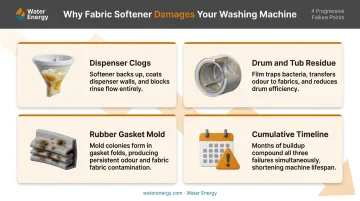
Dispenser Clogs
Liquid fabric softener poured into the dispenser tray can congeal and harden over time — particularly with concentrated formulas or in cold-water cycles. LG's support documentation confirms that excess softener can harden inside the dispenser, recommending weekly cleaning when this occurs. Samsung identifies clogged dispensers, dirty spray jets, and overfilling as the primary reasons softener fails to dispense correctly.
The practical consequences compound quickly:
- The automatic release mechanism becomes restricted
- Softener sits in the tray rather than reaching the wash
- Hardened residue continues building with each load
Drum and Tub Residue
Fatty compounds that don't fully flush out settle on the drum interior, creating a film that traps lint, soil particles, and bacteria. GE's appliance support documentation identifies fabric softener residue buildup in front-load wash baskets as a direct cause of odor, recommending monthly tub cleaning and monthly or bi-monthly dispenser cleaning for households using softener regularly.
Miele similarly notes that softener can accumulate in the dispenser drawer and drum, forming residue that produces an unpleasant smell — fabric softener is a primary driver of the musty odor many machine owners eventually notice.
Rubber Gasket Mold (Front-Load Washers)
Front-load washers are hit harder than top-loaders. The sealed drum design traps moisture against the rubber door gasket, and fabric softener residue accumulating there gives mold and mildew a foothold.
Better Homes & Gardens cleaning expert Jolie Kerr explains that washer gaskets trap moisture and product residue, creating favorable conditions for mold growth. Consumer Reports corroborates this directly, stating that excessive fabric softener use can cause machine buildup and leave residue that results in mold.
The Cumulative Nature of the Problem
None of this damage appears immediately. Someone who uses fabric softener in every load for two or three years is far more at risk than someone who uses it occasionally. If you're continuing to use softener, running a machine-cleaning cycle monthly — as GE recommends — is the minimum maintenance required to slow accumulation.
How Fabric Softener Harms Your Clothes and Fabrics
Absorbency and Performance Loss
The lubricating film that makes fabrics feel soft coats fiber pores — reducing the ability of those fibers to absorb or wick moisture. Whirlpool advises avoiding softener on towels when maximum absorbency is the goal and on moisture-wicking athletic wear because coatings alter fabric performance.
Fabrics to never use softener on:
- Towels (reduces absorbency)
- Moisture-wicking athletic wear (disrupts wicking performance)
- Microfiber cloths (clogs the microscopic fibers that do the cleaning)
- Flame-resistant children's sleepwear (the CPSC warns softeners may reduce flame resistance)
- Water-repellent outerwear (GORE-TEX and REI both instruct users to avoid fabric softener on technical outerwear)
Odor Trapping on Athletic Wear
Nike's care guidance describes softener residue on workout clothing as acting "like glue for odor-causing bacteria," making the garments progressively harder to clean with each wash. This is why athletic wear often smells despite being freshly washed. The softener coating isn't preventing odors — it's locking them in.
The same buildup affects towels too. Waxy residue accumulates on fibers over time, trapping odors and flattening the loft that makes towels feel plush — even when you're using softener specifically to keep them that way.
Spotting and Staining
Undiluted liquid fabric softener poured directly onto dry fabric — or added at the wrong point in the cycle — can leave oily spots and permanent discoloration. The American Cleaning Institute identifies this as a direct cause of softener stains and advises against direct contact between undiluted liquid softener and fabric.
Health and Environmental Concerns
Skin Irritation and Fragrance Allergens
A 2020 peer-reviewed survey of top-selling textile-care products found fragrances and essential oils in 90% of fabric softeners examined. The American Academy of Dermatology notes that scented fabric softener and dryer sheets may contribute to irritation in people with atopic dermatitis.
For households with young children, eczema sufferers, or anyone with sensitive skin, the residue left on fabrics from every wash cycle means ongoing chemical exposure with every wear.
Quaternary Ammonium Compounds in Wastewater
Fabric softeners are a primary source of quaternary ammonium compounds (QACs) entering the water supply. Research confirms the risks are specific and measurable:
- A 2023 peer-reviewed review reports acute and chronic toxicity to aquatic organisms, with some environmental QAC concentrations approaching levels of concern
- A 2024 San Francisco Estuary Institute report detected QACs in wastewater influent, effluent, and surrounding environmental matrices — with certain QAC groups posing measurable risk to bay organisms
- Some QAC structures break down readily in treatment; others persist and accumulate in sediment and biosolids
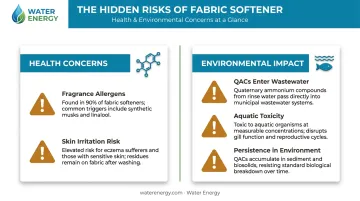
The biodegradation picture varies by compound type. For certain QAC structures, persistence in the environment is well-documented — and the risk to aquatic ecosystems doesn't disappear at the wastewater plant.
Better Alternatives to Fabric Softener
White Vinegar (Rinse Cycle)
Add half a cup of distilled white vinegar to the rinse cycle dispenser. Vinegar helps remove detergent residue from fibers without adding its own coating — and leaves no vinegar smell on dried laundry. It's inexpensive, widely available, and safe for most fabric types.
Consumer Reports warns that vinegar can potentially damage washer hoses and seals with heavy, long-term use — particularly in front-load machines. Use it regularly, but check your washer manufacturer's guidance before making it a daily habit.
Wool Dryer Balls
Three to six wool dryer balls tumbling with laundry physically separate fabric fibers during drying — reducing stiffness and some static without any chemical coating. Good Housekeeping reports they're reusable for hundreds of loads, fragrance-free by default (making them suitable for sensitive skin), and can have a few drops of essential oil added for light scent if desired.
Consumer Reports notes they haven't formally tested effectiveness claims, and wool dryer balls generally don't match dryer sheets for static control. Think of them as a useful mechanical aid — not a direct softener replacement.
Adjusting Wash Habits
Many stiffness complaints attributed to absent fabric softener are actually caused by:
- Overdrying (heat damages fiber structure)
- Overloading the drum (fabrics don't tumble freely and stay compressed)
- Too much detergent (excess detergent residue stiffens fabric just as softener residue does)
Reducing detergent quantity, washing in cold water, and removing clothes from the dryer promptly can meaningfully improve fabric feel without any additive.
Baking Soda
A small amount of baking soda added to the wash cycle can help soften water and improve detergent performance — leaving fabrics feeling naturally softer without chemical residue. It's a low-cost, simple addition that works well alongside reduced detergent quantities.
Water Energy's Storm Ozone Laundry System
For households wanting to skip chemical additives entirely, Water Energy's Storm ozone laundry system works differently from every option above. The Storm dissolves ozone gas directly into wash water — delivering **0.8 to 1.6 parts per million of dissolved ozone** that destroys odor-causing molecules through oxidation, rather than masking them with synthetic fragrance or coating fibers with chemical residue.
Key practical benefits:
- Reduces chemical use by up to 75% — detergent reduced by 70% or more, fabric softener and bleach eliminated entirely
- Hypoallergenic — virtually no chemical residue remains on fabric after washing
- Makes towels softer and fluffier by removing existing chemical buildup from fibers, not just preventing new buildup
- Works with all residential washers — front-load, top-load, and HE machines
- Installs in 30 minutes or less as a DIY wall-mount unit

The technology traces back to a NASA contract in the 1990s, where Water Energy was tasked with cleaning Space Shuttle Solid Rocket Booster parachutes without producing toxic wastewater. Engineers determined ozone was the only compound that could meet NASA's cleanliness standard while leaving zero chemical residues — the same property that makes it effective for laundry.
The Storm Deluxe is priced at $399.
Customer Nancy B. from Texas put it plainly: "No more fabric softener for me. My sheets feel and smell amazing."
Frequently Asked Questions
Is it good to use fabric softener in your washing machine?
Occasional use is unlikely to cause immediate damage. Regular use, especially with concentrated formulas or cold water, leads to cumulative dispenser clogs, drum residue, gasket mold, and degraded fabric performance. The damage builds slowly and often only becomes apparent after months or years.
Where do I put fabric softener in the washing machine?
Most washers have a dedicated softener dispenser compartment, typically marked with a flower icon. Add liquid softener there before starting the cycle; the dispenser releases it automatically at the right time. Never pour softener directly onto clothes. If your washer has no dispenser, add it manually when the rinse cycle begins.
When should I put fabric softener in my washer?
Softener should reach your laundry during the rinse cycle only. Adding it during the wash cycle means detergent flushes it away before it can coat fibers, defeating the purpose entirely. If you're using a dispenser, it handles this timing automatically.
Can fabric softener cause mold in my washing machine?
Yes — particularly in front-load washers. Fabric softener residue creates moist, nutrient-rich conditions in rubber door gaskets and the drum interior that mold and mildew thrive in. Consumer Reports specifically links excessive softener use to machine mold growth.
Does fabric softener damage HE washers?
HE washers use far less water per cycle, so softener stays more concentrated and is harder to fully rinse away. Buildup, clogging, and gasket residue are more pronounced in HE machines than in traditional top-loaders, and concentrated softener formulas make this worse.