
Introduction
Many homeowners assume a water softener handles all their water quality concerns — hardness, taste, odor, and yes, chlorine. It's an understandable assumption, but it's wrong in a way that has real consequences.
Chlorine is present in virtually all U.S. municipal water supplies, and according to the EPA, more than one in five Americans receives water treated with chloramines — a chlorine variant that's even harder to remove. The rest receive water disinfected with free chlorine.
A water softener is built for one specific job: removing hardness minerals. Chlorine isn't a hardness mineral, so it passes through completely untouched. That gap matters more than most homeowners realize — chlorine degrades softener resin over time, affects how fabrics feel after washing, and raises genuine health questions about long-term exposure.
This guide explains:
- What a water softener actually removes (and what it doesn't)
- Why chlorine passes through resin beds unchanged
- What chlorine exposure does to your plumbing, fabrics, and softener
- Which treatment methods actually eliminate it
Key Takeaways
- Standard ion-exchange water softeners do not remove chlorine — it's a dissolved disinfectant, not a hardness mineral
- Chlorine in softened water degrades the resin beads inside your softener over time, shortening its lifespan
- Activated carbon filtration installed before the softener is the most practical whole-house solution
- Beyond taste, chlorine irritates skin, degrades rubber seals, and persists in every tap even after softening
- For laundry-specific chlorine concerns, ozone laundry systems neutralize chlorine at the wash cycle without whole-house plumbing changes
What Does a Water Softener Actually Remove?
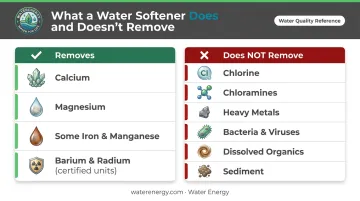
A water softener is designed specifically to remove the calcium and magnesium ions that cause scale buildup — and it does that through ion exchange, nothing more.
What a Standard Softener Removes (and What It Doesn't)
| Removes | Does NOT Remove |
|---|---|
| Calcium (hardness) | Chlorine |
| Magnesium (hardness) | Chloramines |
| Some iron and manganese | Heavy metals (lead, arsenic) |
| Barium and radium (some certified units) | Bacteria and viruses |
| Dissolved organic compounds | |
| Sediment |
The governing standard for residential softeners is NSF/ANSI 44, which covers hardness reduction and — for some certified units — optional barium and radium claims. It makes no chlorine or chloramine reduction claims. Chlorine reduction falls under NSF/ANSI 42, a completely separate standard for filtration systems.
The reason for this separation isn't arbitrary. Hardness minerals are positively charged ions — calcium (Ca²⁺) and magnesium (Mg²⁺) — that bind readily to the negatively charged resin inside a softener. Chlorine exists in water as hypochlorous acid (HOCl) or hypochlorite ion (OCl⁻), neither of which has the ionic properties that interact with softening resin. Chlorine simply passes through unchanged.
How a Water Softener Works — And Why It Can't Remove Chlorine
Understanding the ion exchange process makes it immediately obvious why chlorine removal isn't possible through softening alone.
Ion Exchange: The Core Mechanism
Hard water enters a tank packed with negatively charged resin beads. Calcium and magnesium ions are attracted to these beads and bind to them. In exchange, sodium or potassium ions are released into the water. The result leaving the tank is "soft" water — free of scale-forming minerals.
Chlorine carries none of the ionic properties that trigger this exchange:
- Doesn't bind to resin beads
- Doesn't get swapped for sodium or potassium
- Undergoes no chemical transformation inside the softener
- Exits at the same concentration it entered
The resin simply has no mechanism to capture it.
Regeneration: Resetting the Resin
Even the softener's self-cleaning process doesn't change this. When the resin becomes saturated with calcium and magnesium, the softener runs a regeneration cycle: a concentrated brine solution flushes through, displacing the hardness ions and recharging the beads with sodium.
No stage of this process targets chlorine. The brine flush addresses mineral ion saturation — nothing more. After regeneration, chlorine passes through the freshly recharged resin just as readily as before.
Removing chlorine requires a separate treatment method entirely — most commonly activated carbon filtration, which works through adsorption rather than ion exchange.
Why Chlorine Stays in Softened Water — And Why That's a Problem
After passing through a water softener, chlorine exits at the same concentration it entered. Soft water is not filtered water — a distinction that affects every tap in the house.
Effects on Daily Use
Chlorine in softened water causes several practical problems:
- Skin and scalp irritation: a controlled study published on PubMed found that free residual chlorine at 0.5 mg/L or above reduced water-holding capacity in people with sensitive or atopic skin
- Taste and odor: the characteristic pool-like smell persists in drinking water straight from the softener
- Rubber and elastomer degradation: chlorine (and especially chloramine) degrades gaskets, O-rings, and seals in plumbing fixtures over time
- Laundry impact: chlorinated water affects rinse quality and can accelerate chemical residue buildup in fabrics over repeated wash cycles
Chlorine and Your Softener's Resin
High chlorine exposure actively damages the resin beads inside the softener — and most homeowners don't realize it's happening.
According to DuPont's technical documentation on resin oxidation stability, free chlorine oxidizes strong-acid cation resin through a process called de-crosslinking, which breaks down the polymer matrix that gives resin beads their structure. The result:
- Water retention and swelling increase
- Mechanical integrity weakens
- Ion exchange capacity falls
Recommended maximum chlorine exposure varies by resin type: from 0.2 mg/L for standard gel resin to 0.5 mg/L for high-crosslink macroporous resin at 20°C. Purolite similarly notes that elevated chlorine concentrations can substantially reduce resin service life. Municipal tap water routinely delivers chlorine within or above these ranges, meaning unprotected softener resin is being degraded with every gallon.
Chlorine vs. Chloramine: An Important Distinction
Many municipal systems now use chloramine — a compound of chlorine and ammonia — rather than free chlorine. Chloramine presents two additional challenges:
- It persists longer throughout the water distribution system
- It requires catalytic carbon filtration to remove effectively, not standard granular activated carbon
The Water Quality Association notes that while standard GAC can reduce chloramine with sufficient bed size and contact time, catalytic carbon is the more effective residential medium. If your utility uses chloramine, verify this before selecting a filter.
A Laundry-Specific Consideration
Whole-house filtration handles chlorine across every tap, but there's also a targeted appliance-level option. Water Energy's Storm system injects dissolved ozone directly into the cold water supply feeding the washing machine, treating the water before it contacts the laundry load.
The Storm is designed to eliminate chlorine bleach from the wash cycle and reduce trihalomethane (THM) formation, a byproduct of chlorine reacting with organic matter. It won't filter the home's broader water supply, but it acts at the exact point where chlorine exposure to fabrics occurs.
How to Remove Chlorine from Your Home Water Supply
Carbon-based filtration is the standard solution for residential chlorine removal — the approach recommended by the Water Quality Association, supported by NSF/ANSI 42 certification, and used by most water treatment professionals.
Activated Carbon Filtration
Carbon removes free chlorine through catalytic reduction — chlorine molecules react with the carbon surface and are converted to harmless chloride. This is a chemical reaction, not simple mechanical filtering, which is why carbon is so effective and why it's the right tool for this job.
Two main configurations exist for residential use:
Whole-house carbon tanks (point of entry)
- Installed where the water line enters the home, before the softener
- Handle full household flow rates
- Require minimal maintenance and last for years
- Best option for comprehensive protection
Carbon block cartridge filters
- More affordable upfront
- Better suited to single-point applications (under-sink, countertop)
- Require more frequent cartridge replacement
- Lower flow rates limit whole-house use
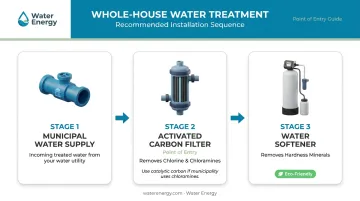
Whichever configuration you choose, placement in the treatment sequence matters. Install the carbon filter before the water softener — this protects the softener resin from chlorine damage while ensuring all household water is dechlorinated before softening.
One additional note on media type: if your municipality uses chloramine rather than free chlorine, confirm the filter uses catalytic carbon rated for chloramine reduction. Standard GAC won't do the job.
Reverse Osmosis as a Point-of-Use Option
Reverse osmosis (RO) systems remove chlorine effectively , but primarily through the carbon prefilter stage that protects the membrane, not the membrane itself. According to the EPA, typical residential RO units may generate five gallons or more of reject water per gallon treated, making whole-house RO impractical for most homes.
Best use case for RO: Under-sink installation for drinking and cooking water, not whole-house chlorine removal. For full-home dechlorination, a point-of-entry carbon tank remains the more practical and efficient choice.
Conclusion
A water softener and a chlorine removal system solve different problems. Assuming one handles both jobs leaves gaps that affect comfort, health, and equipment lifespan.
Pairing a whole-house carbon filter with a water softener protects the softener's resin from oxidative damage, eliminates the taste and odor of chlorine at every tap, and reduces chlorine's effects on skin and plumbing. For households on a municipal water supply, this combination addresses what either system alone cannot — making it a worthwhile baseline rather than an optional extra.
Frequently Asked Questions
What chemicals does a water softener remove?
Water softeners primarily remove calcium and magnesium — the minerals responsible for hardness — and in some cases small amounts of iron and manganese. They do not remove chlorine, chloramines, heavy metals, bacteria, or dissolved organic compounds.
Will chlorine hurt a water softener?
Yes. Chlorine degrades the polymer resin beads through oxidative de-crosslinking, reducing ion exchange capacity and shortening the system's lifespan. A carbon pre-filter installed before the softener is the standard protective measure.
Does a water softener remove chloramine?
No. Chloramine passes through a softener just as free chlorine does. Unlike free chlorine, chloramine requires catalytic carbon filtration to break it down effectively.
What is the best way to remove chlorine from tap water?
A whole-house activated carbon filter installed at the point of entry is the most practical method for removing chlorine from all household water. For drinking water specifically, a reverse osmosis system under the kitchen sink provides additional contaminant reduction.
Can I taste or smell chlorine in softened water?
Yes. Because water softeners don't remove chlorine, the characteristic taste and odor remain in softened water. A carbon filter installed alongside the softener eliminates this completely at every tap.
Does soft water still contain chlorine?
If only a water softener is installed, the water will contain the same chlorine concentration it had when it entered. "Soft water" means reduced mineral hardness — it says nothing about chlorine content. Adding a carbon pre-filter is the simplest way to address both hardness and chlorine in one setup.