GE's Sanitize with Oxi cycle was built to address exactly this gap — combining elevated water temperature with an oxygen-based chemical booster to remove 99.9% of bacteria found in home laundry. The concept is straightforward. The execution is where most people go wrong.
This guide covers what the cycle actually does, what you need before you start, the precise steps to run it correctly, what variables affect your results, and the mistakes most commonly responsible for disappointing outcomes.
Key Takeaways
- The Sanitize with Oxi cycle requires both a detergent and a separate Oxi product — neither alone is sufficient
- Your water heater must supply a minimum of 120°F or the cycle will not sanitize effectively
- Both products go directly on top of the clothes — not in the dispenser drawer
- The water temperature is preset by GE — you cannot change it
- This cycle is for colorfast, heat-tolerant fabrics only — not suitable for every load or fabric type
What Is the GE Sanitize with Oxi Cycle and How Does It Work?
GE offers two sanitization options — and confusing them means either under-sanitizing your load or wasting an Oxi additive that never gets a chance to work.
Standard Sanitize relies on elevated temperature and an extended wash time, followed by a pump purge and deep rinse. No chemical additive is required.
Sanitize with Oxi adds an oxygen-based booster to that process. The combination of heat and active oxygen kills a broader range of bacteria than heat alone.
The Mechanical Sequence
According to GE's documented cycle description, Sanitize with Oxi runs in four distinct phases:
- Concentrated bath — an initial lower water fill creates a high-temperature, concentrated sanitization solution with the detergent and Oxi additive
- Heavy wash — the main wash phase agitates the load through the concentrated solution
- Pump purge — contaminants and residues are cleared from the drum
- Deep rinse — a thorough final rinse removes remaining solution and loosened soils
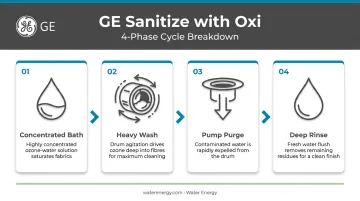
The low initial water fill in step one is intentional — it concentrates the Oxi additive rather than diluting it, which is why product placement matters so much and why dropping it directly into the drum (not the dispenser drawer) makes a measurable difference.
What "Oxi" Actually Means
"Oxi" refers to oxygen bleach — typically sodium percarbonate-based products like OxiClean — not chlorine bleach. When dissolved in hot water, sodium percarbonate releases active oxygen that breaks down bacteria and organic soil at the molecular level.
This distinction matters when shopping: chlorine bleach is not a substitute, and not all "color-safe" alternatives use the same active-oxygen chemistry. Confirm your product contains sodium percarbonate before buying.
How to Run the Sanitize with Oxi Cycle on Your GE Washer
Before You Start: Preparation Checklist
Two things to verify before loading anything:
Water heater temperature. GE requires a minimum of 120°F at the washer's hot water connection. Check your water heater's thermostat — most have an external dial or digital display. If you're unsure of the actual delivery temperature, a cheap thermometer at the tap will tell you.
The U.S. Department of Energy recommends 120°F as the standard residential setting, so if your heater is already calibrated correctly, you're set. If your supply falls below 120°F, the cycle will still run — but it won't sanitize to the 99.9% claim.
Fabric compatibility. Only colorfast, heat-tolerant fabrics should go into this cycle. To test colorfastness: dampen a hidden section of the fabric, press it firmly with a white cloth, and check for color transfer. If dye transfers, skip this cycle for that item.
Fabrics to avoid:
- Delicates, wool, silk
- Synthetics with low heat ratings
- Items with "cold water only" or "dry clean only" labels
- Anything with embellishments, rubber, or heat-sensitive components
Step 1: Load the Washer Correctly
Place clothing or items in the drum first — before adding any products. Don't overload. The cycle starts with a low water fill to create a concentrated solution; an overfull drum reduces contact time between the sanitizing bath and your fabrics, reducing sanitizing effectiveness. Size your load as you would a large, heavily soiled wash.
Step 2: Measure and Add Detergent and Oxi Product
Measure both products using the amounts recommended on each manufacturer's label for a large, heavily soiled load — not the standard amount. Then place both directly on top of the clothes in the drum.
Do not use the detergent dispenser drawer. The cycle's concentrated bath phase happens at the beginning, when the initial water fill is low. Dispensers release product during a different phase of the wash sequence — meaning the Oxi additive misses that critical window entirely.
Products placed on top of the load dissolve directly into the initial bath as intended.
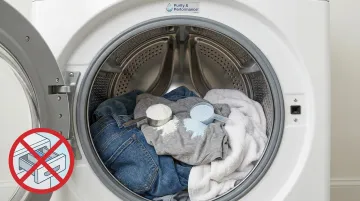
Fabric softener and additional additives should not be used with this cycle.
Step 3: Select and Start the Cycle
Locate "Sanitize with Oxi" on your control panel. On some GE models it may be labeled slightly differently — check your user manual if you don't see an exact match. Once selected, the water temperature setting will appear grayed out or locked; this is intentional. GE presets the temperature for this cycle and does not allow manual adjustment.
Select the cycle and start.
Step 4: Post-Cycle Actions
When the cycle finishes, transfer laundry to the dryer promptly. Leaving damp clothes sitting in the drum creates conditions where bacteria can recolonize — undoing the sanitization you just ran. After removing the load, wipe down the door gasket and seal with a dry cloth to prevent moisture buildup, which contributes to mold growth inside the drum over time.
When Should You Use the Sanitize with Oxi Cycle?
This cycle isn't designed for everyday laundry. Running it too frequently on routine items degrades fabrics faster than necessary and uses more energy than a standard cycle.
Use it when hygiene demands measurably exceed what a normal cycle provides:
- After a household illness — flu, stomach bug, norovirus, skin infection
- Washing cloth diapers or stuffed animals shared among multiple children
- Gym clothes or athletic gear with persistent bacterial odor that regular washing can't resolve
- Items belonging to immunocompromised household members who face elevated infection risk from contaminated fabrics
Do not use it for:
- Delicates, wool, silk, or heat-sensitive synthetics
- Lightly soiled everyday loads
- Any load where your hot water supply can't reach 120°F — the cycle will run, but the 99.9% bacteria reduction claim will not be met
Key Variables That Affect Your Sanitization Results
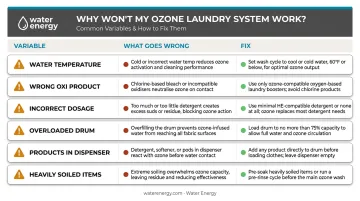
The 99.9% bacteria-removal claim is contingent on specific conditions being met. If any of these variables are off, results fall short of the labeled standard.
| Variable | What Goes Wrong | Fix |
|---|---|---|
| Water temperature below 120°F | Oxi doesn't activate fully; bacterial kill rates drop | Check water heater setting; verify at the tap with a thermometer |
| Wrong Oxi product type | Lower active-oxygen products underperform | Use a sodium percarbonate-based oxygen bleach |
| Incorrect dosage | Too little reduces efficacy; too much leaves residues | Follow manufacturer's "large, heavily soiled" recommendation |
| Overloaded drum | Dilutes the concentrated bath; reduces contact time | Load appropriately — don't pack the drum tight |
| Products in the dispenser | Oxi releases too late, missing the concentrated pre-wash phase | Always place products directly on top of the load |
| Heavily soiled items without pre-treatment | Excess soil partially neutralizes the Oxi before it reaches bacteria | Pre-treat visible stains before running the cycle |
Sodium percarbonate's effectiveness is formulation-dependent. Products containing activators such as TAED improve antimicrobial performance at lower temperatures, while standard sodium percarbonate alone behaves differently. Use a quality powdered oxygen bleach, dose it correctly, and confirm your water supply reaches 120°F before running the cycle.
Common Mistakes and Troubleshooting
Fabric compatibility: Fabrics can shrink, fade, or lose structural integrity. Always perform the colorfast test and check care labels before selecting this cycle for any item you're unsure about.
Detergent drawer placement: The dispenser releases product at the wrong point in the cycle sequence, so the Oxi never reaches the load during the sanitization phase. Both the Oxi and your detergent belong on top of the load.
Still smells or test strips show bacteria: The two most likely causes are water temperature below 120°F or incorrect Oxi dosage. Check your water heater settings first — this is the most common culprit. Then verify your Oxi product is sodium percarbonate-based and that you used the recommended amount for a large, heavily soiled load.
White residue or film on clothes: Usually caused by too much Oxi product or hard water mineral interaction with the oxygen bleach. Reduce the Oxi dosage slightly and run an extra rinse cycle. In persistently hard water areas, a water softener helps prevent mineral buildup from interfering with cycle performance.
Beyond the Built-In Cycle: Ozone as an Alternative for Deeper Laundry Hygiene
The GE Sanitize with Oxi cycle is a capable tool within its parameters, but it has real constraints. It requires a 120°F hot water supply. It can't be used on delicates. It depends on chemical additives and periodic use rather than consistent, every-load hygiene.
For households with ongoing sanitization needs — young children, pets, illness-prone family members, or anyone with sensitive skin — those constraints matter.
How Ozone Laundry Systems Work Differently
Ozone systems sanitize at the water source rather than through a single cycle setting. Dissolved ozone injected into incoming wash water kills bacteria, viruses, and spores on contact: in cold water, without the chemical additives or elevated temperatures that restrict the GE cycle.
Water Energy's Storm system brings this approach to residential use. The technology traces directly to the TecH2Ozone process developed in the 1990s for NASA's Space Shuttle Program, where Water Energy engineers cleaned Solid Rocket Booster parachutes to an extreme standard without generating toxic wastewater.
That same dissolved-ozone mass transfer process, refined across 25 years of commercial laundry applications, is what the Storm delivers to a home washing machine. It runs at 0.8 to 1.6 ppm of dissolved ozone on every load automatically.
The result is sanitization that runs in the background on every cycle, not just when you remember to select a dedicated setting.
Comparing the Two Approaches
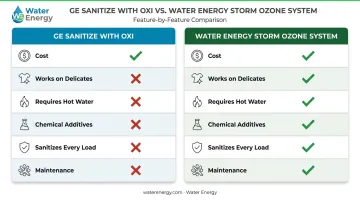
| GE Sanitize with Oxi | Water Energy Storm | |
|---|---|---|
| Cost | Built into GE washers | $399 upfront; no ongoing costs |
| Works on delicates? | No | Yes (cold water, lower chemical load) |
| Requires hot water? | Yes — 120°F minimum | No — effective in cold water |
| Chemical additives needed? | Yes — detergent + Oxi every time | Minimal; most users reduce detergent use by 75% or more |
| Sanitizes every load? | No — selected manually | Yes — automatic on every wash |
| Maintenance | None | None — fully maintenance-free |
The built-in GE cycle is the right tool for periodic deep sanitization of heat-safe items at no extra cost. An ozone system makes more sense when you want consistent hygiene across every load, particularly on fabrics the GE cycle can't touch.
Frequently Asked Questions
What does "Sanitize with Oxi" mean and how do I use it on my GE washer?
It's a dedicated wash cycle that pairs elevated water temperature with an oxygen bleach additive to remove 99.9% of common household bacteria. Add both your detergent and an Oxi product directly on top of the load, then select the cycle — the temperature is preset by GE and locked; you cannot adjust it.
Is the Sanitize cycle worth using on a GE washer?
Yes, for specific situations: after illness, for diapers, gym clothes, or heavily contaminated items. It's not necessary for everyday loads. The cycle only performs as claimed when your hot water supply reaches 120°F and you use a sodium percarbonate-based Oxi product.
Can I use any Oxi product, or does it need to be a specific brand?
GE doesn't require a specific brand, but the product must be an oxygen-bleach (sodium percarbonate-based) additive, not chlorine bleach. For any brand, measure according to the manufacturer's recommendation for a large, heavily soiled load.
What fabrics can I safely wash in the Sanitize with Oxi cycle?
Only colorfast, heat-tolerant fabrics such as cotton, linen, and durable synthetics rated for hot water. Delicates, wool, silk, and anything with a low heat rating should never go into this cycle.
How often should I run the Sanitize with Oxi cycle?
It's an as-needed cycle, not a regular one. Use it after a household member is ill, when washing heavily contaminated items, or periodically for things like cloth diapers. Repeated use accelerates fabric degradation from the combination of high heat and chemical exposure.
Why is my GE Sanitize with Oxi cycle not killing bacteria effectively?
The two most common causes are a water heater set below 120°F and the wrong Oxi product type or dosage. Check your water heater first, then confirm your Oxi product contains sodium percarbonate and that you're dosing for a large, heavily soiled load.