
Research published in PMC identified specific bacteria — including Moraxella osloensis, Acinetobacter, and Pseudomonas species — as the primary drivers of that persistent towel odor. These aren't surface-level germs that a quick wash removes. They embed in towel fibers, survive weak wash cycles, and thrive every time a damp towel sits folded on a hook.
This guide covers exactly why towels develop persistent odors, which methods actually work to remove them, and what it takes to keep them from coming back.
Key Takeaways
- Towel odors come from bacteria, mildew, and detergent residue — not just general dirtiness
- Vinegar and baking soda fix most everyday odors; laundry stripping clears severe buildup
- Too much detergent and fabric softener make odor problems worse over time
- Washing every 3–5 uses and drying immediately are the most effective prevention habits
- Ozone laundry technology eliminates odor-causing bacteria at the source before smells develop
Why Do Towels Smell Bad?
The Two Main Culprits
Towel odor has two sources that typically work together:
- Microbial growth — Bacteria and mildew thrive in damp, dense cotton fibers. A 2023 study found biofilm deep in towel fiber structures, producing odor compounds like dimethyl disulfide and 3-methylbutanoic acid. Standard wash cycles don't always penetrate far enough to clear them.
- Residue buildup — Excess detergent, fabric softener, body oils, and hard water minerals accumulate over time. Consumer Reports confirms that fabric softener deposits a coating on towel fibers that reduces absorbency — and retained moisture creates ideal conditions for bacterial growth.
Habits That Accelerate the Problem
Several common behaviors speed up odor development:
- Leaving towels bunched in the washer after the cycle ends
- Tossing damp towels directly into a hamper
- Storing towels in humid bathrooms with poor ventilation
- Washing on too short or too cool a cycle to kill bacteria
Using too much detergent is itself a major cause of towel odor — and most people don't expect that. Excess detergent that doesn't fully rinse out leaves a residue that traps moisture and feeds bacterial growth: the opposite of clean.
How to Get Smell Out of Towels: Three Quick Methods
Most everyday towel odors respond to one of three accessible approaches. Each method works on a different cause of odor, so matching the method to the problem gets faster results. In all cases, wash towels separately so they have room to move and rinse completely.
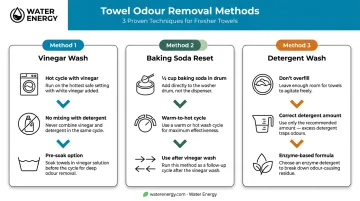
Method 1: Hot Water Wash with White Vinegar
Vinegar's acetic acid helps break down mineral deposits and dissolve odor-causing residue from fibers. Here's the process:
- Run smelly towels through a full hot-water cycle with 1–2 cups of white vinegar added to the fabric softener dispenser
- Do not mix vinegar and detergent in the same cycle — the opposing pH levels reduce the effectiveness of both
- For stubborn cases, pre-soak towels in a sink with 1–2 cups of vinegar for 30 minutes before washing
After the vinegar cycle, dry towels immediately and completely by tumbling on high heat or hanging in a well-ventilated area. Any remaining dampness will reintroduce odor within hours.
Method 2: Baking Soda Reset
Baking soda works differently from vinegar: it neutralizes acidic odor compounds and helps lift detergent residue from fibers.
- Add ½ cup of baking soda directly to the drum with a small amount of detergent
- Run a warm-to-hot cycle
- Works best as a follow-up to the vinegar method — run the vinegar wash first, then the baking soda wash as a second cycle
Don't combine vinegar and baking soda in a single wash. Mixed together, they cancel out before either can do its job.
Method 3: Targeted Detergent Wash
For lighter musty smells, the right detergent at the right load size is often enough:
- Avoid overfilling the machine — towels need room to agitate and rinse properly
- Use the manufacturer-recommended detergent amount, not more
- Select the warmest temperature the care label allows
- Enzyme-based or oxygen-boosting detergents break down body soil better than standard formulas — protein-digesting enzymes target body soils, fat-digesting enzymes handle oils, and activated-oxygen bleach reduces bacteria even in cooler water
How to Deep Clean Severely Smelly Towels
When towels start smelling musty again within one or two uses after a normal wash, basic methods aren't getting deep enough. That's a sign that residue has built up inside the fibers and needs a more intensive approach.
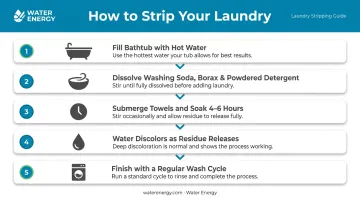
Laundry Stripping
Laundry stripping is a deep-soak method designed to pull years of detergent residue, hard water minerals, fabric softener, and body oil buildup out of towel fibers. Consumer Reports notes it can remove stubborn residue, though it also warns that prolonged exposure to heat and high pH can affect dye and damage delicate fabrics — so treat this as an occasional intervention, not a routine method.
Basic process:
- Fill a bathtub with very hot water
- Dissolve a mixture of washing soda, borax, and powdered detergent in the water
- Submerge towels and soak for 4–6 hours, agitating occasionally
- The water will visibly discolor as residue releases (note: some of this may be dye, not just dirt)
- Finish with a regular wash cycle — no additional products
Pre-Treating Stubborn Spots
For towels with specific odor-heavy areas — gym towels, kitchen towels — apply a small amount of concentrated detergent directly to the affected area. Work it in, wait 5–10 minutes, then load into the machine.
Ozone Laundry Technology
For persistent, deeply embedded odors that keep returning despite stripping and repeated treatments, ozone laundry technology takes a fundamentally different approach. Instead of loosening residue chemically, ozone-infused water oxidizes and destroys odor-causing bacteria and organic compounds at the molecular level — no heat or detergent required.
Water Energy's Storm system, a residential ozone laundry unit built on technology originally engineered for NASA's Space Shuttle Program, delivers 0.8–1.6 ppm of dissolved ozone directly into wash water. Customer Lura H. from Tennessee described the result plainly: "Threw some towels in that were slightly soured and they came out smelling like new — without using any detergent. No perfume smell covering anything up."
Water Energy's roots in this technology go back to the 1990s, when NASA tasked the company with cleaning enormous Solid Rocket Booster parachutes without generating toxic wastewater. That meant penetrating deeply embedded contamination in thick fabric while leaving zero chemical residue behind. The dissolved ozone process engineered for that challenge is what powers the Storm system today.
How to Prevent Towel Odors Long-Term
Most recurring odor problems are habit-driven. Changing a few routines removes the conditions bacteria need to survive.
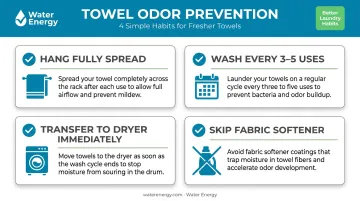
Four High-Impact Prevention Habits
- Hang towels fully spread after every use, not folded or bunched, in a ventilated space where airflow can reach the full surface
- Wash every 3–5 uses under normal conditions, or after every 1–2 uses for gym, kitchen, or beach towels; the American Cleaning Institute recommends this frequency and Cleveland Clinic cites at least weekly as a minimum
- Transfer towels to the dryer immediately after the wash cycle ends — mildew can form within hours in a wet washer drum
- Use only the recommended detergent amount and skip fabric softener on towels entirely : fabric softener deposits a waxy layer that reduces absorbency and traps moisture
Washer Maintenance: The Overlooked Factor
A dirty washing machine can transfer mildew odors directly to your laundry. A 2024 review identified seals, dispensers, sumps, and drums as biofilm sites linked to laundry malodor.
- Run a hot empty cleaning cycle monthly (LG, Whirlpool, and Samsung all publish this as standard maintenance)
- Check the door gasket on front-load machines regularly for trapped moisture and visible mold
- Clean the detergent dispenser drawer, which accumulates residue and can harbor bacteria
Even with solid habits and a clean machine, some households still battle recurring odors — especially in humid climates where bacterial growth accelerates faster than drying can keep up.
For Chronic Odor Problems
In those cases, a structural fix tends to outperform ongoing reactive treatments. The Water Energy Storm system infuses ozone into every wash cycle, eliminating bacteria and odor compounds at the source rather than masking them with fragrance. The result is towels that come out genuinely clean — free of the chemical residue buildup that traps moisture and keeps odors cycling back.
When to Wash, Deep Clean, or Replace Your Towels
| Situation | Action |
|---|---|
| Normal use (3–5 uses) | Standard wash |
| Smells musty after 1–2 uses post-wash | Vinegar reset or laundry stripping |
| Loss of absorbency, visible fiber breakdown | Consider replacement |
| Odor persists after repeated deep cleaning | Replace — typically after 2–4 years of regular use |
| Visible mold spots that won't wash out | Replace immediately |
| Used during a skin infection (ringworm, etc.) | Wash in hot soapy water and don't share — the American Academy of Dermatology does not recommend automatic disposal |
No official health body sets a fixed towel lifespan. Base replacement on condition: if fibers have visibly degraded, absorbency has dropped noticeably, or odors persist after multiple deep cleans, it's time to replace.
Frequently Asked Questions
Why do hotel towels smell so good?
Hotels wash towels at high temperatures with precisely measured detergent, then dry them immediately and completely — no sitting wet. Many also use ozone laundry systems, which sanitize without chemical residue and are documented by the Department of Energy for delivering clean results with significant energy and water savings.
How do I get the musty smell out of towels that won't go away?
Persistent musty odors signal deep residue buildup that basic washing can't reach. Laundry stripping — soaking towels for 4–6 hours in a hot water solution of washing soda, borax, and powdered detergent — followed by a standard wash cycle is the most effective home remedy for this level of buildup.
Why do my towels smell bad right after washing?
Two common causes: using too much detergent (leaving residue that holds odor even after rinsing), or leaving towels sitting wet in the washer too long after the cycle ends. Mildew can begin forming within hours in a damp drum.
Can I use fabric softener to make my towels smell better?
Skip it. Fabric softener deposits a waxy coating on towel fibers that reduces absorbency, traps moisture, and creates conditions where bacteria thrive. It may mask odor briefly, but it makes the underlying problem worse with each use.
How often should I wash my towels to prevent bad smells?
Wash bath towels every 3–5 uses under normal conditions. Gym, kitchen, and beach towels accumulate more sweat, bacteria, and moisture — wash those every 1–2 uses.
Does washing towels in hot water get rid of the smell?
Hot water kills bacteria and dissolves some residue, but it won't eliminate odors caused by deep detergent buildup — a vinegar treatment or laundry stripping is needed for that. Ozone-infused cold water can achieve comparable sanitizing results without the fiber wear that repeated hot washing causes.