Yet many consumers remain skeptical. Claims of "chemical-free disinfection" sound too good to be true, and the underlying science isn't always explained clearly. This guide covers exactly how ozone water destroys pathogens at the cellular level, which specific organisms it eliminates, how it stacks up against chlorine, and where it's used in the real world — from municipal drinking water to home laundry.
Key Takeaways
- Ozone water kills bacteria through oxidative cell lysis — rupturing cell walls and destroying DNA simultaneously
- Effective kill depends on both dissolved ozone concentration and contact time, not concentration alone — this combined measure is called the CT value
- Ozone outperforms chlorine against protozoan parasites like Giardia and Cryptosporidium
- Ozone degrades back to oxygen after use, leaving no toxic chemical residue on surfaces or in water
- A 2024 study identified ozone-resistant bacteria in urban water systems — full resistance is rare but not impossible
What Is Ozone Water and How Is It Made?
Ozonated water is simply water into which ozone gas (O₃) has been dissolved. It's distinct from ozone gas disinfection — where surfaces or air are treated directly — in that the ozone is carried within the water itself, making contact with bacteria on surfaces, in solution, and within fabrics.
Two Ways Ozone Gets Into Water
- Corona discharge — High voltage (typically 6–20 kV, according to the EPA) splits oxygen molecules, and the resulting ozone transfers into water. Most large treatment plants use this approach.
- UV-light generation — Uses 185 nm ultraviolet light to photodissociate oxygen into ozone. Output is lower, making it more common in smaller residential systems.
Why Dissolution Efficiency Matters
Generating ozone is only half the challenge. Getting it to stay dissolved in water — rather than off-gassing before it reaches bacteria — determines real-world performance. This is where mass transfer technology separates effective systems from ineffective ones.
Water Energy's Tech2Ozone process, originally developed for NASA's Space Shuttle Program, was engineered to maximize dissolved ozone concentration in the water stream. The Storm system delivers 0.8 to 1.6 PPM of dissolved ozone to the washer under normal operating conditions.
How Does Ozone Water Kill Bacteria? The Science Explained
The mechanism behind ozone's bacteria-killing power is direct and physical — a process called oxidative cell destruction.
When dissolved ozone contacts a bacterial cell, the O₃ molecule reverts to O₂ — releasing a reactive oxygen atom in the process. That atom attacks and ruptures the bacterial cell wall, destroying structural integrity so completely that the cell can no longer survive or reproduce.
What Ozone Attacks Inside the Cell
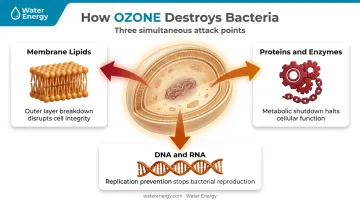
Ozone doesn't stop at the cell wall. It simultaneously targets:
- Membrane lipids, breaking down the protective outer layer
- Proteins and enzymes, shutting down the cell's metabolic function
- DNA and RNA, preventing the bacteria from replicating
This multi-target attack is what makes ozone so effective. A 2021 peer-reviewed review confirmed detrimental oxidation of membrane lipids, proteins, and DNA across pathogenic bacteria. Unlike antibiotics that target one specific pathway, ozone hits everything at once.
The CT Value: Concentration × Contact Time
Effective bacterial kill isn't about concentration alone. The EPA uses a CT value — dissolved ozone concentration (C) multiplied by contact time (T) — to determine whether a given dose is sufficient for a specific organism. There's no single universal threshold; the required CT varies by pathogen. EPA guidance publishes organism-specific tables used in municipal water treatment, illustrating that even tougher pathogens like Cryptosporidium are controllable with the right concentration and exposure time.
Why Ozone Leaves No Residue
After oxidizing bacteria, ozone decomposes back into ordinary oxygen — leaving no chlorinated compounds, no chemical taste, and no residue on surfaces or fabrics. For home laundry use, this means cleaner rinse cycles and gentler results on skin.
One caveat worth knowing: in water containing bromide, ozonation can produce bromate, a regulated byproduct. The EPA sets a maximum contaminant level of 0.010 mg/L, primarily relevant to municipal water treatment systems rather than typical residential laundry applications.
A Note on Resistance
The claim that bacteria cannot develop ozone resistance needs qualification. Ozone's multi-target mechanism makes resistance development difficult — but not impossible. A 2024 study in Environmental Science & Technology identified ozone-resistant bacteria and resistance mechanisms in urban water systems. Resistance is rare and not clinically significant in most applications, but claiming it's categorically impossible overstates the science.
Which Bacteria and Pathogens Does Ozone Water Eliminate?
Research confirms ozone water's efficacy across a wide range of pathogens — though results vary significantly by matrix, concentration, and contact time.
Bacteria: What the Studies Show
| Pathogen | Conditions | Result |
|---|---|---|
| E. coli O157:H7 | 0.82–1.97 mg/L, 5–25 min, in water | 3.9-log₁₀ reduction |
| Staphylococcus aureus / MRSA | ~0.04 mg/L, 2 min, distilled water | 5.4 ± 0.4-log₁₀ reduction |
| Listeria monocytogenes | 0.40–1.0 ppm, 1.5–6 min | 5.6–8.0-log₁₀ reduction |
| Pseudomonas aeruginosa | ~0.10 mg/L, 4 min | 4.8 ± 0.3-log₁₀ reduction |
| Legionella | Concentration-dependent | Modeled 99.99% reduction |
| Salmonella | 2.5–10 ppm, chicken surface | Only 0.3–0.7-log₁₀ |
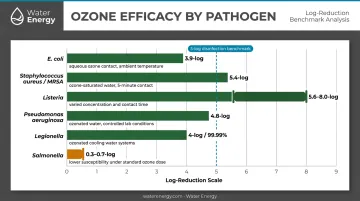
The Salmonella result highlights a critical point: organic matter (protein, soil, tissue) consumes dissolved ozone before it can reach bacteria. Clean water conditions yield dramatically better results than protein-rich matrices.
Viruses and Protozoa
Ozone is highly effective against viruses through the same oxidative mechanism — destroying protein coats and genetic material:
- Murine norovirus: >2-log reduction at 1 mg/L in 2 minutes
- Hepatitis A: Complete 5-log₁₀ inactivation at ≥1 mg/L residual within 60 seconds
- SARS-CoV-2: Inactivation observed at 0.5–1.5 mg/L in a 2025 study, with stronger results at higher concentrations
For protozoa, ozone's advantage over chlorine is substantial. EPA guidance explicitly states ozone is more effective than chlorine, chloramines, and chlorine dioxide against both Giardia and Cryptosporidium. These are organisms that conventional chlorination barely touches at practical concentrations.
C. diff: An Important Clarification
Water Energy's Storm system claims efficacy against C. difficile spores. The strongest published evidence for ozone against C. diff spores comes from ozone gas studies, not dissolved ozone in water. No peer-reviewed studies have confirmed aqueous ozone efficacy against C. difficile spores specifically. Consumers with specific C. diff concerns should request independent test documentation directly from Water Energy.
Ozone Water vs. Other Disinfectants: How Does It Compare?
Ozone vs. Chlorine
| Factor | Ozone | Chlorine |
|---|---|---|
| Protozoan efficacy | Superior — EPA-recognized advantage | Poor against Cryptosporidium at practical doses |
| Speed | Faster-acting at comparable CT values | Slower, requires longer contact times |
| Byproducts | No THMs; can form bromate | Forms trihalomethanes (THMs) and HAAs |
| Residual | Degrades quickly — half-life typically under 30 minutes | Maintains residual through distribution systems |
| Taste/odor | None | Noticeable at higher concentrations |
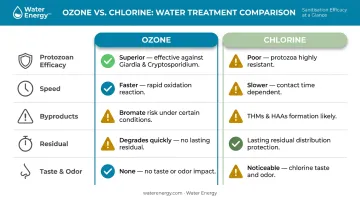
The commonly cited "3,000 times faster than chlorine" claim lacks EPA backing. What the EPA does confirm: ozone requires lower CT values and outperforms chlorine against specific organisms — particularly protozoa like Cryptosporidium — but no universal speed multiplier applies across all conditions.
Ozone vs. UV
Both are chemical-free. The practical difference: UV only disinfects water passing through the light chamber and leaves no residual. Dissolved ozone travels with the water, reaching bacteria on surfaces and in solution throughout a system. In laundry applications, that reach makes a real difference. Ozone-infused water penetrates fabric fibers, contacting pathogens embedded in the material rather than just the surrounding water in the drum.
The Residual Problem
Ozone's biggest limitation is its instability. Half-life ranges from seconds to roughly an hour depending on water temperature, pH, and organic load. Municipal water systems handle this by using ozone as the primary disinfection stage, then adding a chlorine residual to protect water through distribution. For point-of-use applications — like home laundry — the ozone does its work on contact, so the short half-life is a feature, not a flaw: no chemical residue remains on fabric after the wash cycle.
Practical Applications of Ozone Water for Bacteria Control
Municipal Drinking Water
Ozone is an established primary disinfection method in water treatment. A 2017 AWWA survey (published 2021) found ozone use among approximately 10% of responding systems — though this reflects survey respondents, not a national prevalence estimate.
Food Processing and Pools
- FDA authorized ozone as an antimicrobial for food contact use in 2001, covering fruits, vegetables, meat, and food contact surfaces — no chemical residues means it works for organic produce
- The CDC's 2023 Model Aquatic Health Code classifies ozone as secondary treatment in pools and spas, used alongside a residual disinfectant; equipment must meet NSF/ANSI/CAN 50 certification
Ozone Water in Laundry
Dissolved ozone penetrates fabric fibers, reaching pathogens embedded in linens and clothing without requiring hot water or heavy detergents. A 2022 conference poster reported at least 4.3-log₁₀ reduction of HCoV-OC43 (a coronavirus surrogate) within six minutes of ozone washing — though this was a conference poster rather than a peer-reviewed publication, so consider it preliminary until peer-reviewed.
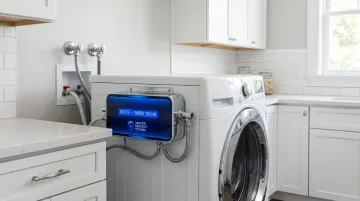
That same disinfection capability — combined with real everyday benefits — is what Water Energy's Storm brings to residential laundry. Using the Tech2Ozone mass transfer process originally developed for NASA, the Storm dissolves 0.8 to 1.6 PPM of ozone directly into the wash stream. At that concentration, a single cold-water cycle:
- Targets bacteria, viruses, and odor-causing pathogens on fabric
- Cuts chemical detergent use by 75% or more
- Eliminates persistent odors without a separate disinfection step
Is Ozone Water Safe? What You Need to Know
Dissolved Ozone vs. Ozone Gas
These are two different exposure scenarios. Dissolved ozone in water — at concentrations used in drinking water treatment and laundry applications — behaves very differently from inhaled ozone gas. OSHA's ozone gas permissible exposure limit is 0.1 ppm over an 8-hour period — an inhalation standard that applies to airborne ozone, not dissolved ozone in water.
Drinking Ozonated Water
Both the WHO and EPA recognize ozone as a safe, approved primary drinking water disinfectant. In properly designed systems, ozone fully decomposes before consumption — you're drinking oxygen-enriched water, not active ozone. Bottled water brands and municipal systems worldwide use ozonation for this reason.
The caveat: in water with elevated bromide content, ozonation can produce bromate. Well-engineered systems monitor for this.
Consumer System Safety
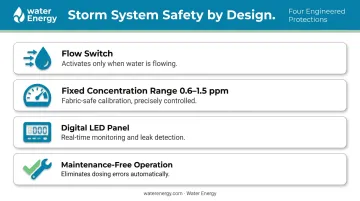
The Storm system manages safety through engineering rather than manual control:
- A flow switch activates ozone production only when water is flowing — preventing accumulation in static water
- The fixed concentration range (0.6–1.5 ppm) is calibrated below levels that damage fabric or pose contact risks
- A digital LED panel provides real-time monitoring, including leak detection
- Maintenance-free operation eliminates dosing errors entirely
Frequently Asked Questions
Is drinking ozonated water good for you?
Ozonated water from properly designed treatment systems is safe to drink — ozone fully decomposes back to oxygen before consumption, leaving clean water without chemical residues. The WHO and EPA both recognize ozone as an approved primary drinking water disinfectant used in municipal systems and bottled water worldwide.
Does ozone kill parasites in water?
Yes. Ozone is highly effective against protozoan parasites like Giardia and Cryptosporidium, outperforming chlorine, chloramines, and chlorine dioxide for protozoan inactivation. That's why many municipal water treatment facilities rely on ozone as their primary disinfection stage.
How long does ozone stay active in water?
Dissolved ozone has a short half-life, typically under 30 minutes (ranging from seconds to roughly an hour depending on temperature, pH, and organic load). It degrades into oxygen quickly, so ozone systems treat water at or near the point of use rather than maintaining residual through a distribution network.
Can ozone water kill viruses as well as bacteria?
Yes. The same oxidative mechanism that ruptures bacterial cell walls also destroys viral protein coats and genetic material. Studies confirm efficacy against norovirus surrogates, hepatitis A, and SARS-CoV-2, with concentration and contact time requirements varying by virus.
What concentration of ozone is needed to kill bacteria?
There's no single universal threshold — the EPA uses organism-specific CT values (concentration × contact time) rather than a fixed ppm figure. Results vary widely: effective kill at ~0.04 mg/L for planktonic MRSA in distilled water versus minimal reduction of Salmonella on chicken at 10 ppm, because matrix and organic load matter as much as concentration.
Is ozone water better than chlorine for killing bacteria?
For most bacteria and viruses, ozone is faster-acting and leaves no chemical taste, odor, or trihalomethane byproducts, and it clearly outperforms chlorine against resistant organisms like Cryptosporidium and Giardia. That said, chlorine's lasting residual is essential for protecting water across long distribution systems, which is why most municipal systems use both.