Steam sanitization sits at an interesting intersection: it can do both in a single pass, using nothing but heat. But how well it works depends heavily on temperature, dwell time, fabric type, and what you're actually trying to kill.
This guide covers how steam sanitization works at a physics level, what it actually eliminates (and what it doesn't), where it genuinely excels, its real limitations, and why cold-water ozone technology is increasingly entering the sanitization conversation.
Key Takeaways
- Steam sanitizes through thermal denaturation — heat destroys bacterial proteins and viral membranes
- Effectiveness depends on both temperature and sustained dwell time, not just a quick steam pass
- NSF Protocol P172 requires a 99.9% microorganism reduction for a certified residential washer sanitizing cycle
- Steam can damage silk, wool, rayon, and other heat-sensitive fabrics — check care labels before sanitizing
- Ozone dissolved in cold water offers an alternative that sanitizes without heat, using oxidative chemistry
What Is Steam Sanitization and How Does It Work?
Steam sanitization uses high-temperature water vapor to penetrate fabric fibers and destroy microbial life through sustained heat exposure. The key distinction: it's not "cleaning" in the conventional sense. It's thermal deactivation — bacteria, viruses, and allergens broken down by heat rather than scrubbed away by detergent.
The Physics of Steam Sanitization
Steam is water heated past its boiling point into vapor form. Because steam molecules exist as individual water vapor particles rather than liquid droplets, they can move through porous materials, fabric weaves, and surface gaps that liquid water cannot easily reach.
The sanitizing mechanism kicks in at the point of contact. When steam hits a cooler surface — fabric, grout, upholstery — it rapidly condenses back into liquid and releases a burst of latent heat energy.
That concentrated heat destroys pathogens directly: it denatures bacterial proteins and disrupts viral membrane structures, breaking apart the biological machinery that keeps them viable.
Temperature thresholds matter here. CDC guidance for healthcare laundry references 71°C (160°F) for 25 minutes as the hot-water benchmark — a conservative standard that accounts for soil load and varying conditions. Lower temperatures can be effective against vegetative bacteria, but always with the qualifier that dwell time, detergent, and load geometry all affect the outcome.
Steam in Washing Machines vs. Standalone Steam Cleaners
These two applications use the same thermal mechanism but in different ways:
Steam washers inject vapor into the drum at various cycle phases (pre-wash, during wash, or post-wash) to boost sanitization and help detergent penetrate fiber more effectively. Steam works alongside water, agitation, and detergent in a combined process.
Standalone steam cleaners (handheld or canister units) direct a focused steam jet at hard surfaces, upholstery, grout, and spot areas. Here, steam is the sole sanitizing agent — no detergent, no mechanical agitation.
The practical implication: washers combine heat, chemistry, and mechanical action for a layered result. Standalone steamers rely on heat alone — so consistent temperature and adequate dwell time aren't optional, they're the whole equation.
What Steam Sanitization Actually Eliminates
To make a legitimate sanitization claim, a process must reduce specific pathogens by a defined percentage. The EPA distinguishes between cleaning, sanitizing, and disinfecting — sanitizing kills bacteria on surfaces, disinfecting kills both bacteria and viruses. For residential washers, NSF Protocol P172 sets the laundry benchmark at a 99.9% microorganism reduction.
Bacteria, Viruses, and Household Pathogens
Steam at sufficient temperature and dwell time can neutralize a range of common pathogens. A peer-reviewed laundry hygiene review documents testing at 55°C for 28 minutes for organisms including S. aureus, E. coli, and Salmonella Typhimurium — with detergent as part of the process.
A few important nuances:
- Fungal spores require significantly more exposure. One study found that decontaminating laundry from Microsporum canis required a 60°C, 90-minute wash cycle with detergent — shorter or cooler cycles failed
- C. difficile spores are particularly resistant. A 2022 study found only a ≤0.37-log reduction of C. diff spores after 71°C for 20 minutes under clean test conditions — meaning standard home steam should not be described as sterilization
- MRSA and influenza benefit from the complete wash process (heat + detergent + drying) rather than steam alone
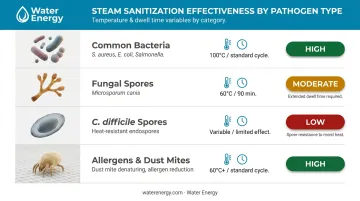
In short, steam temperature alone doesn't determine outcome — dwell time, soil load, and detergent all play a role. Strip any one of those variables and sanitization results become unreliable.
Allergens and Odors
Pathogens aside, steam performs well against a different category of household irritants: biological allergens. Dust mite feces, pet dander, and pollen are all protein-based structures that denature under heat — making steam a genuinely useful tool here.
NSF P351 requires certified washers to achieve at least 95% reduction of house-dust-mite allergen and feline dander at 55°C for a minimum of three minutes. That's the verified benchmark; broader claims about every pet allergen or pollen type should be treated cautiously.
Odors work differently. Steam doesn't mask smells — it breaks down the odor-causing bacteria and their metabolic byproducts directly, making it a more durable fix for persistent sources like gym clothes, towels, and bedding.
The Real Benefits of Steam Sanitization for Home Laundry
For residential use, steam's most practical advantages are:
- Deeper stain and soil removal — steam relaxes fiber structure, letting detergent penetrate more effectively
- Reduced allergen load — effective for bedding, children's clothing, and items that collect dust mite and pet allergen buildup
- Wrinkle reduction — steam relaxes fiber tension, cutting ironing time on compatible fabrics
Unlike disinfectant sprays or bleach, steam sanitizes without adding chemical residue to fabrics — a clear advantage for households with sensitive skin, infants, or anyone with chemical sensitivities.
That same chemical-free mechanism extends beyond fabrics. A standalone steam cleaner handles tile grout, countertops, bathroom surfaces, and hard toys — making it a versatile hygiene tool well outside the laundry room.
Limitations and Trade-Offs to Know
Steam delivers real sanitizing benefits — but the costs and limitations are worth understanding before committing to a steam washer.
Key trade-offs to consider:
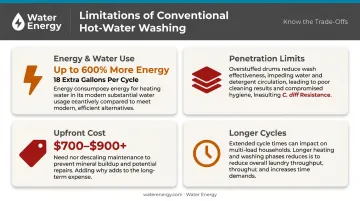
- Energy and water use: Consumer Reports tested seven steam washers and found one model used 18 additional gallons of water and nearly 600% more energy with the steam option enabled compared to a standard cycle. That's one model, not a category average, but it reflects the range of impact. Steam cycles consistently draw more energy than cold or warm standard washes.
- Penetration limits: Steam's sanitizing power depends on maintaining temperature deep into the load. An overstuffed drum or a heavy comforter can prevent steam from reaching interior fibers. It's also not a reliable solution for highly heat-resistant pathogens like C. difficile spores under normal home conditions.
- Higher upfront cost: Steam washer models typically start around $700, with many steam-featured units at the $900+ tier, per Consumer Reports' 2023 data. The steam nozzle also requires periodic descaling — mineral buildup from hard water reduces performance over time.
- Longer cycle times: Steam cycles run longer than standard cycles, which adds up for households running multiple loads per day.
Fabric Safety Guide: When to Use Steam — and When to Skip It
Fabric Safety Guide: When to Use Steam, and When to Skip It
Not every fabric handles steam well. Getting this wrong can cause irreversible damage.
Fabrics that generally handle steam well:
- Cotton and linen
- Polyester and most synthetic blends
- Standard machine-washable fabrics
Fabrics to keep away from steam:
- Wool — moisture plus heat can cause felting and permanent fiber damage
- Silk — protein fibers are heat-sensitive and can lose texture and sheen
- Rayon/viscose shrinks and distorts easily under heat
- Chiffon — its lightweight construction offers little protection against heat deformation
- Items with heat-sensitive dyes, sequins, or adhesive embellishments can bleed, melt, or separate under heat
- Leather and PVC — surface damage occurs quickly
- "Dry clean only" items — the label exists for a reason
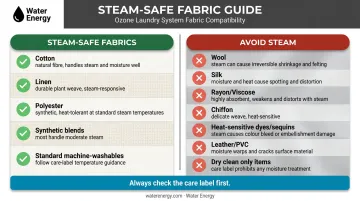
The practical rule: check the care label first. The FTC requires care labels to specify safe washing methods and temperature limits, and GINETEX warns that even the lowest steam setting can permanently damage certain fabrics. When in doubt, skip the steam.
Beyond Steam: Cold-Water Sanitization with Ozone Technology
Steam's fundamental limitation for laundry sanitization is that it requires high heat — which increases energy use, restricts fabric compatibility, and rules out cold-water washing entirely. This has pushed interest toward sanitization methods that work at ambient or cold water temperatures.
How Ozone Sanitization Works
Ozone (O₃) is a highly reactive oxidizing molecule. It destroys bacteria, viruses, mold spores, and allergens by attacking microbial cell walls directly — oxidizing cellular membranes and causing structural breakdown. This entire process happens dissolved in cold wash water, with no heat required.
After ozone completes its action, it converts back to ordinary oxygen, leaving no chemical residue in the fabric or the wastewater. A 2025 peer-reviewed study on ozone-assisted washing found it can contribute to disinfection and reported a 20% shorter washing process under laboratory conditions.
Steam vs. Ozone: A Direct Comparison
| Factor | Steam Sanitization | Ozone Sanitization |
|---|---|---|
| Mechanism | Thermal denaturation (heat kills) | Oxidative destruction (chemical reaction kills) |
| Water temperature | Requires heat | Works in cold water |
| Energy use | High — especially in steam washer cycles | Low — Storm system draws 25 watts |
| Fabric safety | Risk to wool, silk, rayon | Cold water is gentler on all fabrics |
| Chemical residue | None | None (converts back to oxygen) |
| Delicate fabrics | Restricted | Compatible with cold-water washables |
Water Energy's Storm System
Water Energy brings ozone sanitization to the residential laundry market through the Storm system. The product draws from 25 years of commercial ozone experience and the company's work with NASA's Space Shuttle Program, where ultra-clean results were non-negotiable.
The Storm connects inline with any existing residential washing machine and delivers 0.8 to 1.6 ppm of dissolved ozone into the cold wash water using the proprietary Tech2Ozone mass transfer process originally developed for NASA. The company claims it kills COVID-19, Staph, C. difficile, and other pathogens — and cuts chemical use by 75%, with most loads requiring only a small amount of detergent. Installation takes about 30 minutes and requires no professional help.
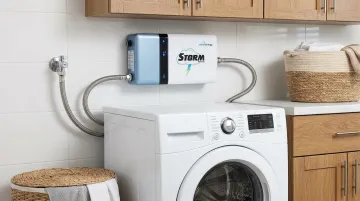
The Storm's pathogen-kill claims are manufacturer-stated figures. The system holds CE RoHS and ISO 9001:2015 certifications (manufacturing quality standards), but independent third-party pathogen efficacy testing data is not publicly documented. Anyone with clinical or compliance requirements should contact Water Energy directly at info@gls².co before making purchasing decisions based on specific kill claims.
Both the Storm Deluxe and Storm OPL Deluxe are available at $399 at waterenergy.com.
When Each Technology Makes More Sense
Steam sanitization is the better fit when:
- You already own a steam washer and are working with compatible fabrics
- Sanitizing hard surfaces like tile, grout, or children's toys
- Refreshing garments without a full wash cycle
Ozone laundry sanitization is the stronger choice when:
- Energy savings and cold-water washing are priorities
- You're washing delicate fabrics that can't handle heat
- Consistent pathogen reduction across every load matters
- Reducing chemical use for sensitive skin households is the goal
Frequently Asked Questions
How does steam sanitization work?
Steam delivers high-temperature vapor that penetrates fabric fibers and surfaces. On contact, it releases concentrated heat energy that denatures bacterial proteins and disrupts viral membrane structures, eliminating pathogens without chemical agents. Effectiveness depends on reaching and sustaining sufficient temperature throughout the material.
Will steam sanitize shrink my clothes?
It can, particularly with heat-sensitive fabrics like wool, silk, and rayon. Always check the care label before using any steam cycle. Reserve steam for cotton, linen, and heat-tolerant synthetics labeled as machine washable to avoid irreversible shrinkage or distortion.
What temperature does steam need to reach to kill bacteria?
Most vegetative bacteria are effectively reduced at sustained temperatures around 60°C (140°F) when combined with appropriate dwell time and detergent. CDC's healthcare laundry benchmark is the more conservative 71°C (160°F) for 25 minutes. Temperature alone is not sufficient — sustained exposure is critical.
Does steam sanitize replace detergent?
No. Steam enhances sanitization and helps detergent penetrate fibers more effectively, but it doesn't replace detergent's role in lifting and removing soil. Per CDC guidance, detergent, water temperature, and complete drying all play a role. Steam is an adjunct to that process, not a substitute for it.
Is there a way to sanitize laundry without heat or steam?
Yes. Ozone (O₃) dissolved in cold wash water sanitizes through oxidation rather than heat — no hot water or chemical agents required. Systems like the Water Energy Storm bring this commercial laundry method to residential use, infusing every cold wash cycle with dissolved ozone.