
Introduction
The average American family runs about 300 loads of laundry per year, according to ENERGY STAR — and depending on the machine, each load can consume anywhere from 10 to 24 gallons of water. That adds up fast, especially when drought conditions are tightening water supplies across the country.
Most of that consumption is avoidable. Traditional top-loading machines use nearly twice the water of front-loaders per cycle. Many households run partial loads daily, default to extra rinse settings, and re-wash clothes that didn't need washing in the first place.
This guide breaks down all three layers of laundry water waste: the habits driving unnecessary cycles, the machine settings that inflate per-load consumption, and the equipment upgrades that cut water use at the source. Whether you're running an older top-loader or a brand-new HE machine, you'll walk away with specific, actionable changes that can reduce your water use — starting with your next load.
Key Takeaways
- Front-loaders use ~10 gallons per load vs. 16–24 for traditional top-loaders — machine type is the single biggest structural factor
- ENERGY STAR-certified washers save ~2,000 gallons per year vs. standard machines
- Full loads, correct water level settings, and cold water washing are the highest-impact behavioral changes
- Ozone laundry systems like Water Energy's Storm cut water use by up to one-third through shorter wash cycles and lower detergent demand
- Greywater reuse from rinse cycles is permitted in many US states, though local regulations vary — confirm before installing any collection system
How Water Use in the Laundry Room Adds Up
Laundry water consumption doesn't feel like a big expense — because it doesn't arrive all at once. It compounds load by load, week by week, until the annual total becomes surprisingly large.
The pattern is gradual and habitual. A household running partial loads every day, keeping the extra rinse cycle on by default, and washing lightly worn items after a single use is using far more water than a household that doesn't. No alarm goes off. No single load looks egregious. The waste hides in the routine — and because each cycle seems normal, the cumulative water footprint rarely gets the same scrutiny as a utility bill spike.
A few numbers that put it in context:
- Consumer Reports' 2026 testing shows traditional top-load agitator machines use 16–24 gallons per average load
- Front-loaders average about 10 gallons per load; HE top-loaders average around 13 gallons
- At 300 loads per year, the difference between a top-loader and a front-loader can exceed 3,000 gallons annually
Those figures reflect machine type alone. Behavioral habits — load size, cycle selection, wash frequency — can push that number even higher, or bring it meaningfully down.
Key Drivers of Washing Machine Water Consumption
Machine Type
Machine architecture is the single biggest structural driver of water use. Traditional top-loading agitator machines submerge clothes in a full tub of water — the wash action requires it. Front-loaders and HE top-loaders tumble clothes through a much smaller volume of water, achieving the same mechanical cleaning action with far less.
The gap is significant:
| Machine Type | Gallons Per Load |
|---|---|
| Traditional top-load agitator | 16–24 gallons |
| HE top-loader | ~13 gallons |
| Front-loader | ~10 gallons |
| ENERGY STAR certified (average) | 14 gallons |
| Standard washer (ENERGY STAR comparison) | 20 gallons |
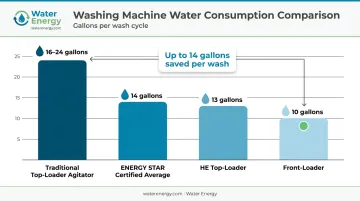
Source: Consumer Reports (2024), ENERGY STAR (2024)
Across 300 loads per year, a household with a standard top-loader uses roughly 1,800–3,000 more gallons than one running a front-loader.
Behavioral Habits
Machine type sets the ceiling — habits determine whether you reach it or exceed it. The main behavioral drivers of excess water use:
- Partial loads — a half-full machine uses nearly as much water as a full one
- Extra rinse cycles — adds several gallons per load when used as a default rather than when genuinely needed
- Over-washing lightly worn items — jeans, towels, and outerwear often don't need washing after one use
- Excess detergent — creates suds that require longer, more water-intensive rinse cycles to clear
A newer HE machine paired with poor habits can end up using more water than an older machine operated thoughtfully. Machine type and behavior interact — addressing only one layer typically delivers limited results.
Water-Saving Strategies for Your Washing Machine
Effective water reduction requires working all three layers: what you decide before washing, how you operate your machine during a wash, and what equipment your setup relies on.
Strategies That Reduce Water Use by Changing Your Laundry Habits
Run only full loads. A half-full machine uses almost as much water as a full one. Consolidating loads is the single highest-impact behavioral change for most households. The water savings are immediate, and there's no equipment cost involved.
Pre-treat stains instead of re-washing. Re-washing a load doubles its water footprint. A targeted pre-treatment applied before the first wash eliminates the second cycle entirely. Build it into your routine for anything prone to stubborn stains.
Extend the life of lightly worn items. Jeans, towels, outerwear, and hoodies rarely need washing after one wear. Each unnecessary cycle adds 10–24 gallons depending on machine type. Washing only what's actually soiled is an easy way to cut total annual load volume.
Stop defaulting to the extra rinse cycle. The extra rinse exists for cases of genuine detergent buildup, not as a standard setting for every load. Using the correct detergent quantity for the load size eliminates the need for it in most cases, saving several gallons per cycle.
Strategies That Reduce Water Use by Changing How You Operate Your Machine
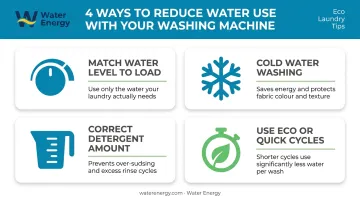
Match the water level to the load size. Most machines let you select a water fill level (small, medium, large). Running a small load on the highest setting wastes water that's doing no cleaning. Always select the setting that matches what's actually in the drum.
Switch to cold water washing. ENERGY STAR notes that water heating accounts for roughly 90% of washer operating energy. Cold water is also gentler on fabrics and works effectively with modern detergent formulations. Beyond the energy savings, it allows for shorter, more efficient cycles.
Use the right amount of detergent. Excess detergent doesn't clean better. It suds more, requiring longer rinse cycles and more water to clear. Using the manufacturer-recommended quantity (or less with concentrated formulas) keeps rinse cycles short and effective.
Use eco or quick cycles for lightly soiled loads. Most modern machines offer shorter cycle options that use less water and energy. These aren't cutting corners. For everyday loads that aren't heavily soiled, they clean just as well.
Strategies That Reduce Water Use by Upgrading Your Equipment and Setup
Upgrade to a high-efficiency or front-loading washing machine. ENERGY STAR-certified washers average 14 gallons per load compared to 20 gallons for standard machines, saving approximately 2,000 gallons per year. ENERGY STAR also reports certified front-loaders are about 50% more water-efficient than agitator top-loaders. If you're running an older top-loader, replacing it is the single highest-impact equipment decision you can make.
Consider greywater reuse from your washing machine. Rinse water from the washing machine can be redirected to garden irrigation using a hose diverter or greywater system. Key considerations before setting one up:
- Check state and local regulations — rules vary significantly by jurisdiction
- Avoid using greywater on edible crops
- Switch to low-sodium, plant-safe detergents to protect soil health
- Arizona, California, Oregon, and Washington each allow residential laundry greywater under specific conditions
Right-size your machine to your household's actual needs. An oversized machine running small loads wastes water on every single cycle. An undersized machine forces more frequent runs. Matching machine capacity to your household's actual weekly laundry volume is a one-time decision with a permanent effect on water efficiency.
Consider an ozone laundry system for advanced water reduction. Ozone-based residential systems dissolve ozone directly into cold water, which acts as a powerful cleaning and sanitizing agent. This reduces reliance on hot water, detergent, and extra rinse cycles. Less detergent means less residue in the fabric — and less water needed to rinse it out.
Water Energy's Storm system brings 25 years of commercial ozone laundry experience to the residential market, built on technology first developed for NASA's Space Shuttle Program in the 1990s. The Storm Deluxe and Storm OPL Deluxe are both priced at $399, install inline on the cold water supply line in about 30 minutes, and require no plumber.
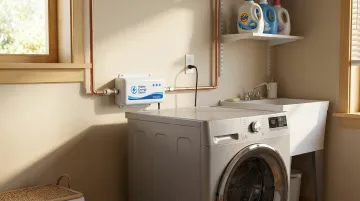
Water Energy reports water use reductions of up to one-third per load. That figure is based on internal testing rather than published third-party data, so if independent verification matters to your decision, contact Water Energy directly at info@gls².co for technical documentation before purchasing.
Conclusion
Reducing washing machine water use comes down to identifying which layer of waste applies most to your household — and targeting it directly.
Start with habits: full loads, correct water levels, cold water, and the right detergent quantity. Those changes cost nothing and deliver immediate results. Then look at machine settings, eco cycles and the default extra rinse setting especially. Finally, evaluate equipment — whether that's upgrading to an ENERGY STAR-certified machine, exploring greywater reuse, or adding an ozone system to reduce per-load water demand structurally.
The strategies compound. A household that adopts better habits, operates its machine more efficiently, and upgrades its equipment doesn't just save water once — it cuts water use on every load, year after year. Even modest changes across all three layers can add up to thousands of gallons saved annually — without sacrificing clean results.
Frequently Asked Questions
How to save water when using a washing machine?
Always run full loads and select the water level that matches your load size. Use cold water, avoid the extra rinse cycle by using the correct detergent quantity, and consider upgrading to a high-efficiency machine or adding an ozone system to reduce per-load water demand structurally.
How long can water sit in a washer?
Whirlpool and Consumer Reports both advise removing wet laundry as soon as the cycle ends. Prolonged moisture creates mildew conditions, which often leads to re-washing and doubles that load's water use.
Does cold water washing clean clothes as effectively as hot water?
For most everyday laundry, yes. Modern detergents are formulated to perform in cold water, and ozone-based systems clean and sanitize effectively without heat. Hot water remains useful for heavily soiled or greasy items, but it's unnecessary for the majority of household loads.
What is the most water-efficient type of washing machine?
Front-loading machines use approximately 10 gallons per load compared to 16–24 gallons for traditional top-loaders. HE top-loaders fall in between. That efficiency gap adds up to thousands of gallons saved annually. ENERGY STAR-certified models provide verified benchmarks to compare when purchasing.
How much water does a washing machine use per load?
Water use depends on machine type. Traditional top-load agitators use 16–24 gallons per load, HE top-loaders use around 13, and front-loaders use about 10. ENERGY STAR estimates standard machines average 20 gallons versus 14 gallons for certified models.
Can I reuse washing machine water for my garden?
Rinse-cycle greywater can be redirected to garden irrigation, but check your state and local regulations first, as rules vary by jurisdiction. Avoid using it on edible crops, and use low-sodium, biodegradable detergents to protect soil health.