Introduction
Most conventional cleaning products never fully disclose what's inside them. You spray, scrub, and rinse — and the chemicals you don't know about linger on surfaces, vaporize into the air you breathe, and rinse into waterways. According to the EPA, concentrations of several organic pollutants average 2 to 5 times higher indoors than outdoors — and cleaning products are a significant contributor.
Shoppers also have no reliable way to evaluate what they're buying. "Natural" on a cleaning label means nothing legally — the term is completely unregulated, leaving brands free to apply it however they like.
This guide cuts through that confusion. Below, you'll find a tested roundup of genuinely non-toxic cleaning brands across categories — all-purpose, laundry, kitchen, and beyond — plus a breakdown of how each was evaluated and what to watch for when you shop.
Key Takeaways
- Natural cleaning products can match conventional ones for most everyday household tasks — without harsh chemical residues.
- "Natural" is unregulated on labels; look for EPA Safer Choice, Made Safe, or EWG Verified seals instead.
- Only 7% of cleaning products adequately disclose their full ingredient list, making certification non-negotiable.
- Concentrates and refillable systems cost significantly less per use than single-use bottles.
- For laundry specifically, ozone-based systems can eliminate the need for most detergent chemicals — cutting both chemical exposure and ongoing costs.
Why Switching to Non-Toxic Cleaning Products Matters
The Labeling Gap No One Talks About
Federal law does not require companies to disclose every ingredient in a cleaning product. Fragrance components — which can draw from a palette of more than 3,500 chemicals according to EWG — may remain entirely hidden behind the single word "fragrance."
That gap is widespread. According to Consumer Reports, EWG found that only 7% of assessed cleaning products adequately disclosed their contents.
That matters because some of what's hiding in those labels carries real concerns:
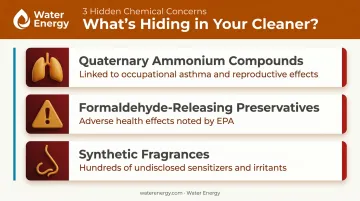
- Quaternary ammonium compounds (quats) — found in many disinfectant sprays — are associated with work-related asthma in occupational studies, and animal studies have reported reproductive effects
- Formaldehyde-releasing preservatives appear in several cleaner categories; the EPA notes formaldehyde exposure may cause adverse health effects
- Synthetic fragrances can contain hundreds of undisclosed components, including sensitizers and irritants
Who Faces the Highest Risk
Some households face higher daily exposure than others:
- Young children crawl and play on floors and surfaces where residues concentrate
- Infants and toddlers put hands and objects in their mouths after surface contact
- People with respiratory conditions or sensitive skin react to irritants that others tolerate without symptoms
- Pets walk across freshly cleaned floors and ingest residues during grooming
Cleaning vs. Disinfecting: A Practical Distinction
According to the CDC, routine cleaning is usually sufficient at home. Disinfection — which requires registered chemical agents — is mainly warranted when someone is sick, has recently visited while sick, or a household member is at higher risk. For the vast majority of everyday cleaning tasks, well-formulated natural products are entirely appropriate.
Best Natural and Non-Toxic Cleaning Products — Tested
These products were selected based on ingredient transparency, real-world cleaning performance, third-party certifications, packaging sustainability, and value. Categories covered range from whole-home concentrates to laundry-specific formulas.
Branch Basics
Branch Basics is a woman-owned brand built around a single plant-based concentrate that replaces an entire cabinet's worth of cleaners. One bottle, diluted at different ratios, handles all-purpose surfaces, bathrooms, laundry, and baby items. It's fragrance-free, biodegradable, non-GMO, and Made Safe certified — with organic chamomile among its naturally derived ingredients.
The concentrate model is what sets it apart. Instead of juggling multiple products with unknown formulations, you get one verified formula at different dilutions.
| Details | |
|---|---|
| Best For | All-purpose whole-home cleaning; families wanting to simplify their cleaning cabinet |
| Key Certifications | Made Safe certified, cruelty-free (Leaping Bunny), biodegradable, third-party tested |
| Price Range | Premium Starter Kit: $75 / 33.8 oz Concentrate refill: $55 |
Blueland
Blueland is a B Corp, Climate Neutral certified, BIPOC- and woman-owned brand that ships water-free cleaning tablets. Customers receive a reusable bottle once, then refill it with dissolvable tablets for multi-surface, dish, laundry, and hand soap use. The model cuts out the need to ship water-heavy products across the country.
With over 25,900 reviews on their Clean Essentials Kit, plus certifications covering cruelty-free status, PFAS-free formulation, and zero single-use plastic, it's one of the most comprehensively verified options on this list.
| Details | |
|---|---|
| Best For | Zero-waste households transitioning away from single-use plastic cleaning products |
| Key Certifications | B Corp, Climate Neutral, Leaping Bunny, PFAS-free, third-party tested |
| Price Range | Clean Essentials Kit: $46 one-time / $36.80 with recurring refills |
Puracy
Puracy is an Austin-based, family-owned brand with doctor-developed formulas guaranteeing at least 98.5% natural ingredients across its line. Products are made in the USA, free from sulfates, parabens, and synthetic fragrances, and explicitly safe for babies, young children, and pets.
The stain remover and multi-surface concentrate are particularly well-reviewed for tackling tough stains without harsh agents. A subscription model and concentrate refill options reduce both cost and packaging waste over time.
| Details | |
|---|---|
| Best For | Families with babies, young children, or sensitive skin; those prioritizing US-made products |
| Key Certifications | Third-party tested, cruelty-free, vegan, biodegradable, American made |
| Price Range | Laundry Detergent: from $19.99 sale / Laundry Pacs: $24.99 one-time or $19.99 subscription |
Dirty Labs
Dirty Labs is an American-made, BIPOC-owned brand that uses bio-enzyme technology — including their proprietary Phytolase enzyme — to deliver serious stain-fighting performance without petrochemical surfactants, synthetic dyes, or artificial fragrances. Their Free & Clear laundry detergent carries EPA Safer Choice certification, EWG Verification, and recognition from the National Eczema Association.
Packaging uses aluminum canisters, recyclable cardboard, and bamboo scoops, cutting plastic use significantly across the product line.
| Details | |
|---|---|
| Best For | Laundry-focused households; people with eczema or chemical sensitivities; heavily soiled fabrics |
| Key Certifications | EPA Safer Choice, EWG Verified (Free & Clear), cruelty-free, vegan, biodegradable, American made |
| Price Range | Bio Enzyme Detergent (32 loads): $16 / Bio Enzyme Booster: $38–$42 per refill |
ECOS
ECOS has been making plant-derived cleaning products since 1967 — one of the longest track records in the category. Manufacturing runs on 100% renewable energy with carbon- and water-neutral practices. Products are available at major retailers nationwide, making ECOS the most accessible option on this list for shoppers who prefer not to order online.
Note that EWG Verified status applies to select ECOS products rather than the full catalog, so it's worth checking individual product ratings before buying.
| Details | |
|---|---|
| Best For | Budget-conscious shoppers; those buying at local retailers rather than online |
| Key Certifications | EWG Verified (select products), third-party tested, cruelty-free, vegan, biodegradable, FSC certified packaging |
| Price Range | Check current pricing at major retailers or ecos.com — official site prices were not verified at time of publication |
How We Chose These Products
The Evaluation Framework
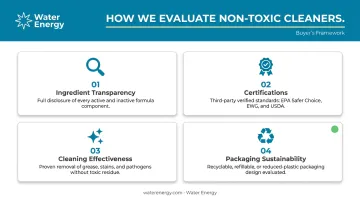
Every product in this guide was assessed across four criteria:
- Ingredient transparency — Are all ingredients named and verifiable, without "fragrance" or "surfactant" hiding what's actually inside?
- Certifications — Is the non-toxic or eco claim independently verified by EPA Safer Choice, Made Safe, EWG Verified, or comparable bodies?
- Cleaning effectiveness — Does it actually remove grease, stains, and grime in real-world conditions?
- Packaging sustainability — Does the brand reduce plastic, offer refills, or use recycled or recyclable materials?
The Greenwashing Problem
Terms like "green," "natural," "plant-derived," and "eco-friendly" are completely unregulated — any brand can print them on any product. Before purchasing, cross-reference claims against EWG, Made Safe, or EPA Safer Choice databases. That step takes under two minutes and is the only reliable shortcut.
Think Cost Per Use, Not Sticker Price
A higher sticker price doesn't mean a product costs more. Concentrates and refillable systems almost always win on a per-use or cost-per-load basis once you account for how long they last.
Two quick benchmarks worth knowing:
- Starter kits from concentrate brands (typically $45–$80) replace multiple conventional bottles and refill for months
- Single-use spray bottles often cost more per ounce and generate more plastic waste in the process
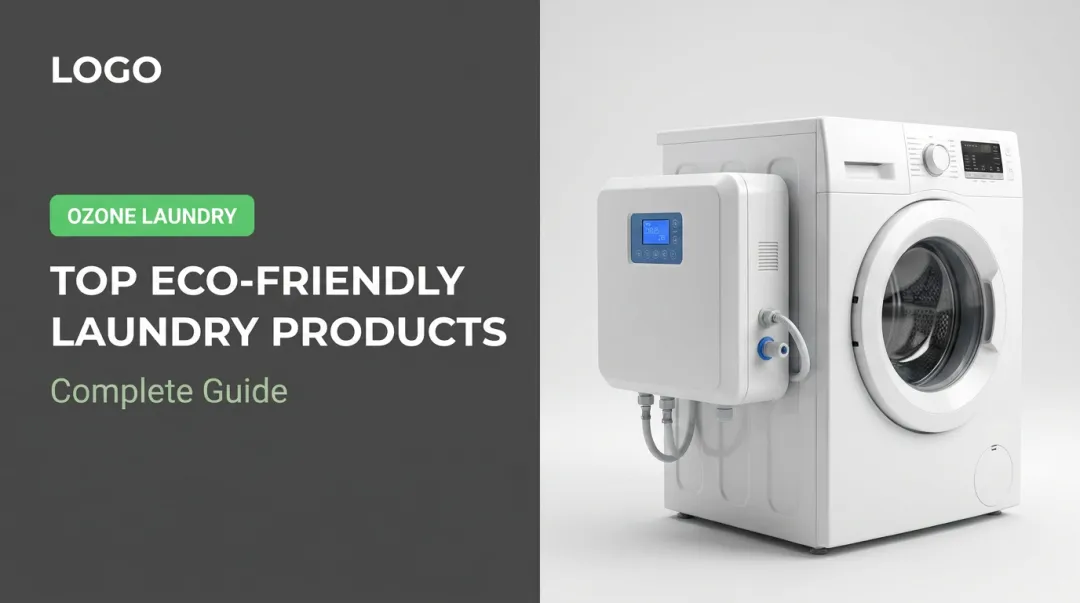
What About Laundry? The Case for Going Chemical-Free with the Water Energy Storm
Even the cleanest plant-based laundry detergents still introduce some chemistry into fabrics and water. For people with skin conditions, allergies, or households with very young children, that residual exposure matters.
How Ozone Laundry Works
Ozone (O₃) is a naturally occurring oxidizing molecule that destroys odor-causing compounds and organic soils on contact — then reverts to ordinary oxygen, leaving no chemical residue on fabrics or in discharge water. The technology has been used in commercial laundry operations for decades.
The Water Energy Storm brings this to residential homes using the same Tech2Ozone process originally developed for NASA's Space Shuttle Program in the 1990s. NASA tasked Water Energy's engineers with cleaning the Solid Rocket Boosters and their enormous recovery parachutes without generating toxic wastewater. Every conventional chemical was off the table. Ozone was the only solution that met NASA's zero-residue requirement, and the resulting mass transfer technology became the foundation for the Storm system.
What the Storm Delivers
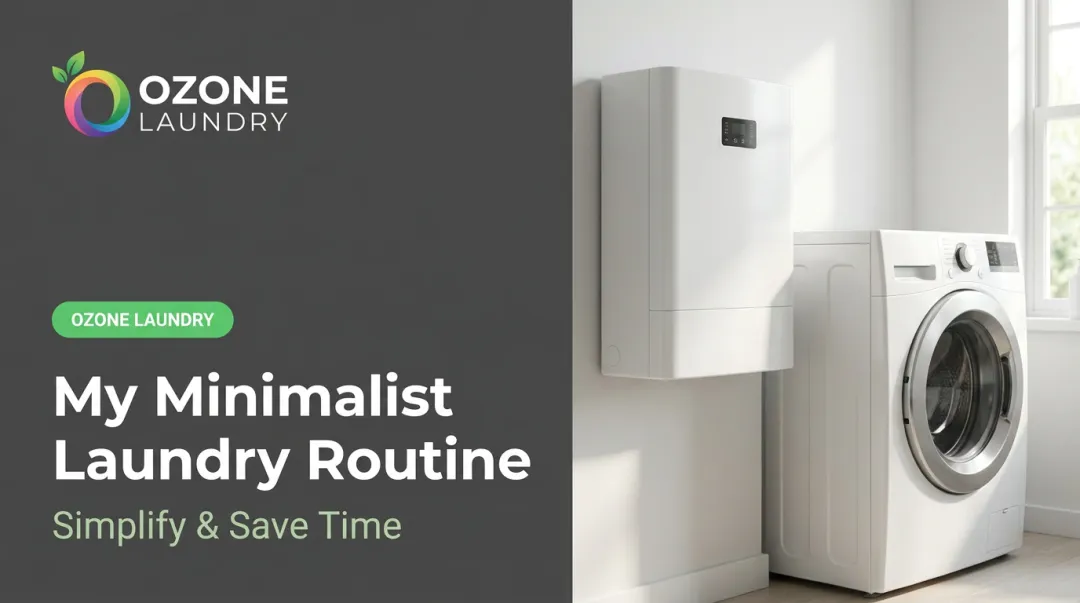
The GLS² Storm Deluxe connects to your existing washing machine (compatible with all residential washers, including HE models) and installs in under 30 minutes. It dissolves ozone directly into cold water at 0.8–1.6 parts per million — enough to:
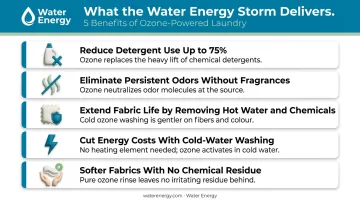
- Reduce detergent use by up to 75% (many users report washing with no detergent at all for standard loads)
- Eliminate persistent odors (body odor, smoke, mildew, pet smells) without fragrances masking them
- Extend fabric life by removing the two primary stressors: hot water and harsh chemicals
- Cut energy costs by eliminating hot water from the wash cycle
- Leave fabrics softer, since no chemical residues cling to fibers
Both models — the Storm Deluxe and Storm OPL Deluxe — are priced at $399 and carry CE RoHS certification and ISO 9001:2015 manufacturing quality certification. The system is maintenance-free with no consumables to replace.
Who It's Best For
The Storm suits households where chemical reduction is a priority:
- Families with young children or anyone managing eczema, allergies, or chemical sensitivities
- Pet owners dealing with persistent odors on bedding and gear
- Households looking to cut detergent costs and eliminate plastic packaging entirely
- Anyone committed to cold-water washing without sacrificing cleanliness
The Storm is not a surface cleaner — for counters, kitchens, and bathrooms, the brands covered above remain the right tools. But for laundry specifically, ozone takes a fundamentally different approach: nothing added to fabrics, nothing left behind in the wash water.
Frequently Asked Questions
Which cleaning products are truly chemical-free?
No product is literally free of chemicals — water itself is a chemical. The practical standard is "free from harmful synthetic chemicals." Products with fully disclosed plant-derived or mineral-based ingredients come closest, as do technology-based systems like ozone that use no chemical additives.
Are natural cleaning products as effective as conventional ones?
For most household tasks — surfaces, laundry, kitchen, and bathroom — well-formulated natural products perform comparably to conventional ones. Some heavy-duty disinfecting scenarios may require stronger agents, but CDC guidance confirms these situations are the exception, not the rule, in everyday home use.
What ingredients should I avoid in household cleaning products?
Key ingredients to avoid: synthetic fragrances (which hide hundreds of undisclosed chemicals), quaternary ammonium compounds like benzalkonium chloride (linked to occupational asthma), formaldehyde-releasing preservatives, chlorine bleach for routine use, and artificial dyes that contribute nothing to cleaning performance.
What certifications should I look for?
- EPA Safer Choice — every intentionally added ingredient reviewed against health and environmental criteria
- Made Safe — screens against a banned/restricted list of 15,000+ substances
- EWG Verified — requires full ingredient disclosure including fragrance components down to 0.01%
- B Corp — company-wide commitment to people and planet (not a product ingredient seal)
- Leaping Bunny — cruelty-free across the supply chain
Can I make effective non-toxic cleaners at home?
Yes. White vinegar and water handles general surfaces, baking soda works for scrubbing, and diluted castile soap cleans dishes and floors. Note: these are not EPA-registered disinfectants and shouldn't substitute for clinical-grade disinfection.
Is ozone safe and effective for laundry?
Ozone is a naturally occurring molecule used for decades in commercial laundry and water treatment. When dissolved into wash water at controlled concentrations — as in systems like the Water Energy Storm — it effectively eliminates odors and organic soils without leaving chemical residues on fabrics.