The health costs are quieter but persistent. Chemical residues from fabric softeners, optical brighteners, and synthetic fragrances sit against your skin all day. Families with children or sensitive skin carry a higher exposure burden.
The good news: switching to a natural, low-waste laundry routine doesn't mean accepting worse results. This guide covers the cleaning agents that actually work, how to replace the most problematic conventional products, and the habits — from water temperature to drying methods — that cut your environmental footprint without extra effort.
Key Takeaways
- NPE surfactants in conventional detergents are EPA-classified aquatic toxins — plant-based formulas skip them entirely
- 90% of washing machine energy goes to heating water — cold water washing is the single biggest energy lever in your laundry room
- Baking soda and white vinegar handle odors and softening — add them in separate cycle stages, not together
- Synthetic fabrics shed up to 700,000 microplastic fibers per wash, making fabric choice as consequential as product choice
- Ozone laundry systems clean at a molecular level in cold water and leave zero chemical residue on fabric or in wastewater
Why Switch to a Natural and Low-Waste Laundry Routine
The Environmental Case
According to ENERGY STAR, the average American family washes about 300 loads per year, with a standard washer using roughly 20 gallons per load. ENERGY STAR-certified machines use approximately 20% less energy and 30% less water than standard models — meaning the equipment you choose matters, but so do the products you put in it.
Conventional detergents introduce a different problem downstream. Nonylphenol ethoxylates (NPEs) — surfactants found in many commercial formulas — break down into compounds more toxic than the original ingredient.
The EPA classifies nonylphenol and NPEs as highly toxic to aquatic life, persistent in the environment, and capable of degrading into shorter-chain versions that accumulate in sediment and wildlife.
The Health Case
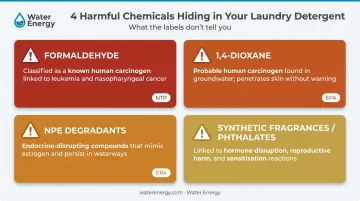
Environmental damage is only part of the story — what stays on your clothes after washing is a separate concern. Optical brighteners, synthetic fragrances, formaldehyde-releasing preservatives like quaternium-15, and manufacturing contaminants like 1,4-dioxane can remain on fabric and transfer to skin through wear.
Key offenders and their documented risks:
- Formaldehyde is a known human carcinogen per the National Toxicology Program, yet still used as a preservative in some detergent formulas
- 1,4-Dioxane is a manufacturing byproduct the EPA's 2024 risk evaluation linked to unreasonable cancer risk
- NPE degradation products are classified as endocrine disruptors in peer-reviewed literature
- Synthetic fragrances often list phthalates and hormone-disrupting compounds simply as "fragrance" — with no further disclosure required
Households with young children or sensitive skin face higher cumulative exposure since fabric contact is constant.
The Waste and Cost Case
Plastic detergent packaging is difficult to recycle at scale, and most residential recycling streams don't successfully process laundry jugs. Concentrated formats, refill systems, and DIY powder recipes dramatically reduce packaging waste — some eliminating it entirely.
Cost is another reason to reconsider the conventional approach. ENERGY STAR notes that heating water accounts for roughly 90% of a washing machine's operating energy — so switching to cold water alone cuts operating costs substantially. Lower detergent use and longer fabric life from gentler wash conditions compound those savings over time.
Natural Cleaning Agents: What Actually Works
Not all natural alternatives perform equally. Some work well for odor control and light loads; others can damage specific fabrics if misused. Matching the right agent to the right job matters.
DIY Pantry Staples: Baking Soda, Vinegar, and Lemon
Baking soda (sodium bicarbonate) neutralizes acidic odors through an acid-base reaction — the American Chemical Society confirms this chemistry works. Add ½ cup directly to the drum before loading clothes. It's effective for deodorizing and brightening lightly soiled items.
White vinegar works as a fabric softener substitute in the rinse cycle. Add ½ cup to your machine's softener dispenser or rinse compartment. It removes detergent residue and reduces musty smells without coating fibers the way conventional softeners do.
Two important caveats:
- Don't combine them in the same load. Baking soda and vinegar neutralize each other on contact. Use baking soda in the wash stage, vinegar in the rinse.
- Avoid baking soda on wool and silk. Woolmark recommends neutral-pH detergents for wool; alkaline agents can stress protein-based fibers over time.
Two more pantry options round out the toolkit for whites:
- Lemon juice — mild natural brightener and antibacterial agent; add to the wash cycle for white fabrics
- Hydrogen peroxide (3% household solution) — a gentler oxygen-based bleach alternative for light brightening on whites and color-safe items; never mix with chlorine bleach
Neither baking soda nor vinegar replaces detergent for heavy grease or significant soil — they're best suited to maintenance washing and odor control.
Plant-Based and Natural Soaps
When buying commercial "natural" detergents, look past marketing language and check ingredients. A genuinely natural formula is:
- Biodegradable and petroleum-free
- Free of synthetic fragrances (phthalates hide here)
- Free of optical brighteners (low biodegradability, some skin sensitization risk)
- Free of NPEs, phosphates, quaternium-15, and 1,4-dioxane
The EWG's Guide to Healthy Cleaning rates laundry products by ingredient safety — it's a practical tool for comparing brands before you buy.
DIY laundry powder recipe (works best for lightly soiled loads):
- 1 cup grated castile soap
- 1 cup washing soda
- ½ cup baking soda
- ¼ cup coarse salt
Pulse in a food processor until powdered. Use 2–3 tablespoons per load. The ingredients overlap with other household cleaning uses, so packaging waste is minimal.
Ozone Laundry Technology
Ozone (O₃) dissolved into wash water works through a fundamentally different mechanism than soap or heat. As a powerful natural oxidizer, it destroys bacteria, viruses, and odor-causing compounds at the molecular level without relying on detergents or hot water. After oxidation, ozone reverts to ordinary oxygen, leaving zero chemical residue on fabric or in wastewater.
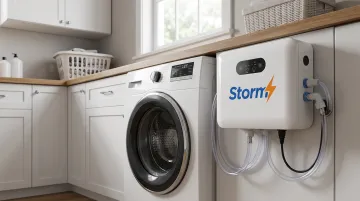
Water Energy's Storm brings this technology to residential laundry. The company's roots are in NASA's Space Shuttle Program: in the 1990s, NASA tasked Water Energy engineers with cleaning the Solid Rocket Booster parachutes without generating toxic wastewater.
The solution, the TecH2Ozone dissolved ozone mass transfer process, proved so effective that it was later applied to commercial laundry and, after 25 years of commercial deployment, adapted for home use as the Storm.
Key specs and outcomes:
- Delivers 0.8–1.6 ppm dissolved ozone to the washer
- Works exclusively in cold water
- Reduces chemical detergent use by up to 75%
- Reduces water use up to one-third through shorter wash formulas
- Leaves no residue — towels get fluffier, fabrics last longer, drying times shorten
- Compatible with all residential washers, including HE front-load and top-load models
- Maintenance-free: nothing to add, replace, or adjust
- Installs in 30 minutes without a plumber at $399
For families with sensitive skin, that residue-free result matters most. Customer Shirley M. from Texas reported that her special-needs grandchild, who had persistent rashes and breakouts from laundered clothing, stopped reacting entirely after switching to ozone washing.
Building Your Natural Laundry Routine Step-by-Step
Before the Wash
Start upstream. Most clothes don't need washing after a single wear unless visibly soiled, and the habit of washing after every single use was largely driven by detergent industry marketing. Wearing clothes two or three times before washing reduces total load volume, water use, and fabric wear.
When you do wash:
- Sort clothes into full loads only — half-loads waste water and energy proportionally
- Pre-treat stains naturally: dab hydrogen peroxide with a small amount of castile soap on the spot, or rub a damp bar of natural soap directly on the stain before loading
- Run synthetic fabrics in a Guppyfriend washing bag — a 2020 study found it reduces microfiber release to wastewater by approximately 54%, a practical, evidence-backed option for cutting microplastic pollution
During the Wash
Wash nearly everything in cold water. ENERGY STAR confirms that water heating accounts for about 90% of a washing machine's operating energy — switching from hot to warm cuts that in half, and cold reduces it further. Modern detergents are formulated for cold water and perform comparably to warmer cycles on everyday loads.
Additive swaps:
- Fabric softener → ½ cup white vinegar in the rinse dispenser
- Brightener → ½ cup baking soda in the drum (not combined with vinegar)
- Conventional detergent → plant-based enzyme formula or DIY powder for light loads
Always select the correct load size setting. Oversized settings on small loads waste significant water.
Hot water is still appropriate for heavily soiled items, sanitizing linens after illness, or washing very greasy fabrics. For everything else, cold performs well.
Drying and After-Wash Care
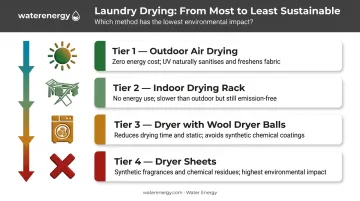
Drying hierarchy, from most to least sustainable:
- Outdoor air drying — sunlight acts as a natural antibacterial and whitener; turn colored items inside out to prevent UV fading
- Indoor drying rack — effective in cooler climates, uses zero energy
- Dryer with wool dryer balls — wool balls replace dryer sheets, reduce static, soften fabric, and improve air circulation to speed drying. Add a few drops of essential oil to a ball for light scent.
- Dryer sheets — avoid; contain synthetic fragrance and coating chemicals
Always clean the dryer lint screen after every load — blocked screens reduce efficiency and create a fire risk.
Sustainable Laundry Habits That Reduce Waste
Small shifts in what you buy, how you package your detergent, and how you handle specialty items add up across hundreds of loads a year.
Fabric Choice Matters
What you wear determines how much microplastic pollution your laundry generates.
A peer-reviewed study found that a single 6 kg acrylic wash can release more than 700,000 microfibers — fibers that pass through wastewater treatment and enter waterways and food chains.
When buying new clothing, prioritize:
- Organic cotton, linen, hemp, and wool
- Tightly woven fabrics over loosely knit synthetics
- Quality over quantity — fewer washes total
- A Guppyfriend bag for synthetics you already own, to trap shedding fibers at the source
Low-Waste Packaging
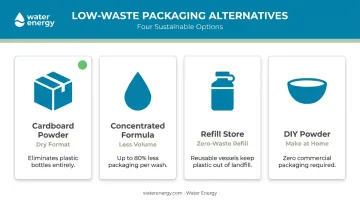
Packaging choices compound over 300 loads a year:
- Cardboard over plastic — powder detergents in cardboard are far easier to recycle than HDPE jugs
- Concentrated formulas — fewer loads per ounce of packaging
- Refill stores — bring your own container, zero new packaging
- DIY powder — reduces packaging waste to near zero, ingredients serve multiple household uses
A Note on Dry Cleaning
Most conventional dry cleaners use perchloroethylene (PERC), which the EPA's 2024 TSCA rule identified as posing unreasonable health risks — including neurotoxicity, kidney and liver effects, and cancer — establishing a 10-year phase-out ending in 2034.
Greener alternatives exist now:
- Professional wet cleaning — water-based, non-toxic, widely available
- Liquid CO₂ cleaning — solvent-free alternative recognized by the California Air Resources Board as a non-toxic PERC substitute
Check labels carefully before assuming an item requires professional dry cleaning. The FTC's care labeling rule means a "Dry Clean Only" label appears specifically when the manufacturer has evidence that washing will damage the item — so treat it as a real warning, and seek wet cleaning over PERC-based methods when professional care is needed.
Conclusion
A natural, low-waste laundry routine is a collection of deliberate decisions, not a single product swap. Washing in cold water, replacing fabric softener with vinegar, pre-treating stains naturally, choosing natural fiber clothing, and using a Guppyfriend bag for synthetics all compound into real reductions in chemical exposure, energy use, and plastic waste.
The options scale to fit most households:
- Pantry staples like baking soda and white vinegar handle most light loads effectively
- Plant-based enzyme detergents step in for heavier soil and stubborn stains
- Ozone laundry systems like Water Energy's Storm eliminate chemical detergents almost entirely, cleaning at a bacterial level using the same ozone process the company developed working with NASA on the Space Shuttle Program
Pick the level that fits your household and start there — even one or two swaps make a measurable difference.
Frequently Asked Questions
Can cold water really clean clothes as effectively as hot water?
For most everyday laundry, yes. Consumer Reports' testing confirms that modern detergents are designed for cold water and perform comparably to warmer cycles on standard loads. Hot water remains the better choice for heavily soiled items, greasy fabrics, or sanitizing linens after illness.
Is it safe to mix baking soda and vinegar in the same laundry load?
No — combining them triggers a neutralizing reaction that cancels out both agents' benefits. Use baking soda in the wash stage and white vinegar in the rinse cycle separately to get effective results from each.
What are the most harmful chemicals to avoid in laundry detergents?
The main offenders are NPEs, synthetic fragrances (which often contain phthalates), optical brighteners, formaldehyde, 1,4-dioxane, and quaternium-15 — a formaldehyde-releasing preservative. The EWG's Guide to Healthy Cleaning lets you check specific products by name.
Do natural laundry alternatives work as well as conventional detergents?
For lightly soiled loads, baking soda and vinegar perform well. Heavily soiled or greasy items call for a plant-based enzyme detergent. Ozone-based systems like Water Energy's Storm go further — destroying bacteria and stubborn odors at the molecular level without any chemical additives.
How can I reduce microplastic pollution from my laundry?
Use a Guppyfriend washing bag for any synthetic garments — independent testing shows it reduces microfiber release to wastewater by about 54%. Prioritize natural fiber clothing for new purchases, and minimize wash frequency by wearing items more than once before laundering.
How does an ozone laundry system differ from baking soda or vinegar?
Baking soda and vinegar work at a surface level — neutralizing odors and adjusting pH. Dissolved ozone is a powerful oxidizing agent that destroys bacteria, viruses, and odor compounds at the molecular level in cold water, without any chemical additives. After oxidizing contaminants, it reverts to ordinary oxygen, leaving no residue on fabric or in wastewater.