Most people discover this the hard way. A few washes with fabric softener, a cycle on hot, and towels that once cleaned effortlessly start smearing instead of cleaning. The damage is often permanent.
This guide covers everything: machine washing steps, hand washing technique, drying and storage best practices, the most common mistakes to avoid, and how often to wash based on use type.
Key Takeaways
- Wash microfiber separately from cotton and other lint-producing fabrics — always
- Use a fragrance-free, additive-free liquid detergent in minimal quantity (about 1–2 teaspoons)
- Never use fabric softener, dryer sheets, or bleach — they clog or coat the fibers permanently
- Cool or warm water only; high heat damages thermoplastic fibers
- Air dry or tumble dry on the lowest heat setting
- Store clean microfiber in an enclosed container to prevent lint and dust contamination
Why Proper Microfiber Towel Care Matters
Microfiber towels work because of their fiber construction. Products like the MW Pro Multi-Surface Towel use an 80% polyester/20% polyamide blend with strands approximately 1/100th the width of a human hair. That extreme fineness creates thousands of tiny fiber "fingers" that physically grab dirt, oil, and moisture rather than just pushing them around.
Both polyester (PET) and polyamide are thermoplastic polymers — meaning they respond to heat and can stiffen or degrade when exposed to temperatures outside their tolerance range. This is why high heat is so damaging: it doesn't just shrink the towel, it alters the fiber structure in ways that reduce softness and absorbency permanently.
Residue is the other major threat. Fabric softeners, scented detergents, and excess detergent all deposit a coating on those fine fibers. According to The Rag Company's microfiber care guide, softeners and dryer sheets coat the fibers and actively inhibit absorption — the fibers become coated rather than open and ready to capture particles.
How Long Should Microfiber Towels Last?
Manufacturer claims vary significantly by brand and product:
- E-Cloth guarantees most products for 100 washes
- Microfiber Wholesale claims 300+ washes for standard towels and 500+ cycles for their MW Pro line
These are brand-specific figures, not universal benchmarks. What they share is the assumption that the towels are washed correctly. Improper care, such as hot water, softener, or washing with cotton, can cut that lifespan dramatically — often well before the towels lose their physical structure, meaning you'll see degraded cleaning performance long before the fabric visibly wears out.
How to Machine Wash Microfiber Towels
Machine washing is the most practical method for regular microfiber care. Done right, microfiber towels hold up for years. Done wrong, they lose effectiveness within a dozen washes.
Step 1: Sort and Separate
Always wash microfiber towels in a load by themselves. Microfiber aggressively traps particles (including lint from cotton towels, terry cloth, and clothing). Microfiber Wholesale confirms that washing with cotton or wool transfers lint that embeds in the fibers and reduces effectiveness.
Also separate by use type: heavy-duty cleaning towels should not share a load with light dusting cloths, both to prevent cross-contamination and to allow appropriate pre-treatment.
Step 2: Shake Out Excess Dirt
Before loading the washer, shake each towel vigorously over a trash can. This removes loose dirt, dust, and debris so the washer isn't fighting a heavy particle load, and reduces debris recirculating through the wash water.
Step 3: Choose the Right Detergent
- Use a fragrance-free, dye-free, additive-free liquid detergent
- Dose conservatively (roughly 1–2 teaspoons per load)
- Microfiber-specific detergents (like Rags to Riches from The Rag Company) are the cleanest option
- Never use powder detergents, scented formulas, or heavy-duty enzyme cleaners
Less detergent is always better for microfiber. Excess detergent accumulates in the fibers with each wash, progressively reducing absorbency.
For households looking to cut chemical use further: Water Energy's Storm ozone laundry system is a natural fit for microfiber care. The Storm runs exclusively in cold water (ideal for thermoplastic fibers) and delivers 0.8–1.6 ppm of dissolved ozone directly into the wash water. Ozone sanitizes and cleans on its own, which is why many users wash with little to no detergent at all.
Because ozone reverts to oxygen after the oxidation process, it leaves zero chemical residue in the fibers. Customer Lura H. from Tennessee described washing soured towels "without using any detergent" with results that "came out smelling like new" — a direct solution to the buildup problem that degrades microfiber over time.
Step 4: Select the Right Cycle and Temperature
| Soil Level | Water Temperature | Cycle |
|---|---|---|
| Lightly soiled | Cool | Gentle or permanent press |
| Heavily soiled | Warm | Normal or permanent press |
| Never | Hot | Any cycle |
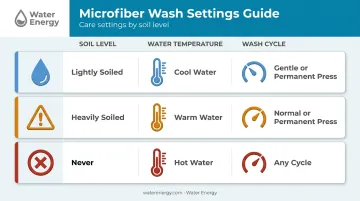
Check your towel manufacturer's guidance. Microfiber Wholesale permits warm water up to 160°F for their towels, while E-Cloth caps at 140°F. Temperature limits differ by brand, so verify before washing on warm.
Step 5: Pre-Treat Heavily Soiled Towels
For towels with ground-in grime or persistent odors, soak them in a bucket of cool water with a small amount of detergent for 15–30 minutes before the wash cycle. A tablespoon of white vinegar added to the rinse can help break down detergent residue and neutralize odors. Microfiber Wholesale references this as manufacturer-compatible guidance.
How to Hand Wash Microfiber Towels
Hand washing works well for lightly used towels — dusting cloths, for example — and is accepted by major manufacturers including Norwex and Microfiber Wholesale.
The process:
- Shake out loose dirt over a trash can
- Fill a basin or bucket with cool water
- Submerge towels and massage by hand to loosen particles
- Soak for 15 minutes
- Give a final scrub by hand, focusing on soiled areas
- Rinse thoroughly under clean running water until water runs clear
- Wring out excess moisture gently — don't twist
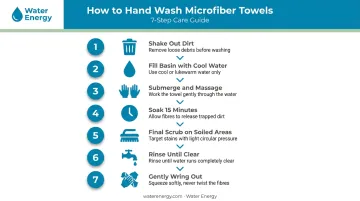
For lightly soiled dusting cloths, no detergent is necessary. The mechanical action of massaging in clean water is often sufficient.
Once washed, hang towels to air dry in a well-ventilated area, with natural sunlight working best. Never store them until completely dry. Damp microfiber kept in an enclosed space develops mold and mildew fast, leaving a sour smell that's hard to remove.
How to Dry and Store Microfiber Towels
Drying
Preferred method: Air dry on a flat surface or hang on a line in good airflow.
If using a dryer:
- Select the lowest heat setting or air-only cycle
- Clean the lint trap thoroughly before loading — lint in the trap transfers directly to microfiber
- Skip dryer sheets entirely (E-Cloth advises against them) (E-Cloth advises against them)
- Never dry microfiber in the same load as cotton items
Microfiber Wholesale sets a dryer maximum of 140°F for their towels. E-Cloth and The Rag Company offer qualitative guidance — low heat or air dry — rather than a specific temperature ceiling.
Storage
Once your towels are fully dry, move them straight to an enclosed container — a lidded plastic bin or sealed zip bag works well. Open shelf storage exposes microfiber to airborne dust and lint, which compromises cleaning performance over time.
Organize stored towels by use type — kitchen towels separate from bathroom cloths, heavy-duty cleaning towels separate from polish applicators. That way, you can grab the right towel without rummaging through the stack.
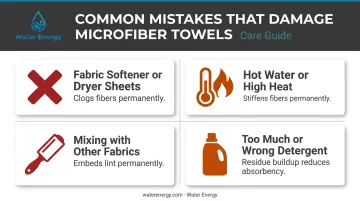
Common Mistakes That Damage Microfiber Towels
Fabric Softener or Dryer Sheets
Both products deposit a waxy coating on the fiber surfaces that clogs the fine "fingers" responsible for trapping dirt and absorbing moisture. The absorbency loss is permanent — no wash cycle fully reverses it. Keep both away from microfiber entirely.
Hot Water or High Heat Drying
The thermoplastic fibers in microfiber respond to excessive heat by contracting and stiffening. The result is a towel that feels rough or scratchy and no longer absorbs water well. A towel damaged this way won't recover — the structural change to the fibers is permanent.
Mixing with Other Fabrics
Cotton towels, fleece, and most clothing shed lint. Microfiber is so effective at trapping particles that it will grab that lint and hold it — permanently. Wash microfiber with microfiber only.
Too Much or the Wrong Detergent
Powder detergents and scented or heavy-duty liquid formulas leave behind residue that builds up with each wash. One to two teaspoons of a plain liquid detergent per load is sufficient. More detergent means more residue, not cleaner towels.
When to Replace Microfiber Towels
Retire a towel when it shows these signs:
- No longer absorbs water effectively or beads water rather than pulling it in
- Feels rough or scratchy instead of soft
- Leaves streaks rather than a clean, dry surface
- Has been used to apply ceramic coating products — those residues are very difficult to wash out fully, and the towel may scratch paint if reused
Frequently Asked Questions
Can you wash microfiber towels in hot water?
Avoid hot water. Microfiber is made from thermoplastic polyester and polyamide, which can shrink, stiffen, or lose their split-fiber structure under high heat. Cool or warm water — depending on soil level — is the appropriate range for most microfiber products.
How often should you wash microfiber towels?
Towels used for heavy-duty or greasy cleaning tasks should be washed after every use. Lightly used dusting cloths can typically go 2–3 uses before washing, adjusted for soil level.
Can you use fabric softener on microfiber towels?
Never. Fabric softener deposits a waxy residue that physically clogs the ultra-fine fibers, destroying absorbency and cleaning performance. Dryer sheets cause the same problem and should also be skipped entirely.
Should microfiber towels be washed separately from other laundry?
Yes, always. Microfiber traps particles so effectively that lint shed by cotton and other fabrics will embed permanently in the fibers during a shared wash. Keep microfiber loads exclusively with other microfiber items.
How do you know when microfiber towels need to be replaced?
Key signs include poor water absorption, a rough or scratchy texture, streaking on surfaces after use, or persistent odors that survive a proper wash cycle. Once these appear consistently, it's time to replace the towel.
Can microfiber towels go in the dryer?
Yes, but only on the lowest heat or air-only setting. High heat permanently damages the thermoplastic fibers. Clean the lint trap before drying, skip dryer sheets, and never dry microfiber alongside cotton items.