

The fix isn't a better folding method or a bigger laundry room. It's two things working together: owning less so there's genuinely less to wash, and building a small, repeatable routine so laundry never snowballs into a weekend project again.
This post walks through both. By the end, you'll have a practical framework for cutting laundry down to something that takes minutes a day instead of hours on Sunday.
Key Takeaways
- Fewer clothes means less laundry — both how often you wash and how much at once
- Small loads done daily or every other day take far less total time than one big weekly session
- Cold water washing cuts energy costs, protects fabrics, and handles most everyday laundry effectively
- Folding immediately after drying is the single habit that eliminates the "clean pile" problem
- Keeping supplies to a minimum — one detergent, one mesh bag, one drying rack — removes clutter and decision fatigue
Start With Your Wardrobe: Less Clothing Means Less Laundry
The most overlooked laundry tip has nothing to do with laundry: it's about how much you own.
More clothes means longer cycles before anything needs rewashing. That sounds convenient, but it produces enormous, intimidating loads and a wardrobe full of clothes in ambiguous "clean or dirty?" limbo.
When you can't tell whether something is ready to wear, it ends up in the wash anyway — wasted water, wasted energy, unnecessary fabric wear.
WRAP's 2022 survey of 6,000 UK adults found that the average wardrobe contained 118 garments, with 31 items — about 26% — not worn in the prior year. That's a lot of clothing contributing to laundry volume without contributing much to daily life.
Aim for One Week's Worth
The minimalist target is roughly one week's worth of clothing per person. This creates a natural rhythm: when the hamper is full, it's time to wash. Loads stay small, and nothing sits forgotten in the back of a drawer.
To make a smaller wardrobe actually work day-to-day:
- Stick to neutrals and versatile basics so every piece mixes with everything else — fewer "rejected outfit" piles on the floor
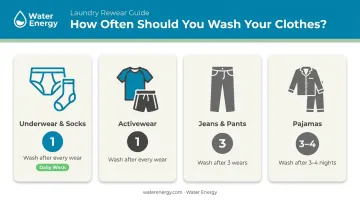
- Rewear outer layers before washing — jeans hold up for about 3 wears, pajamas for 3–4 nights, per the American Cleaning Institute
- Wash underwear, socks, and activewear after every use; assess everything else individually before tossing it in the hamper
Wearing items an extra time or two before washing isn't a hygiene compromise — it's just accurate. Most outer garments don't accumulate meaningful soil in a single wear. A household of four that rewears outer layers just one extra time can easily eliminate one full load per week.
Build a Simple Weekly Laundry Schedule
The case against the big weekend laundry session isn't just about effort — it's about what happens when you wait. Stains set. Loads get forgotten in the washer and need rewashing. The pile becomes so large it feels impossible to start.
Small, consistent loads are a better system. Here's a routine that works:
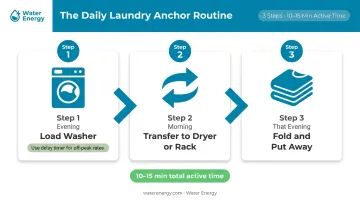
- Evening: Load the washer. If your utility offers time-of-use pricing (off-peak rates can run much lower than peak-hour rates), use the delay timer to run the cycle overnight
- Morning: Transfer to the dryer or drying rack
- That evening: Fold and put away before bed — not tomorrow, tonight
This three-step anchor takes about 10–15 minutes of active time per day, spread across natural pauses in your schedule.
A Few Scheduling Specifics
Sheets and towels: Many minimalists keep one set of each. Strip the bed, wash, and remake it the same day. No storing multiple sets, no rotation system to manage.
Hamper as trigger: When it's visually full, that's the signal to wash. One hamper per person — or one per household for couples — keeps the system clear. No guessing, no counting.
Involving others: A small, defined daily task is far easier to delegate than an overwhelming weekly event. When laundry is clearly scoped (one load, start to finish), partners and older kids are much more likely to participate without prompting.
That discipline around timing pays off in another practical way. Texas A&M AgriLife Extension notes that time and heat make stains much harder to remove. Fresh stains respond to a cold water rinse. Old stains need products, effort, and sometimes luck.
Simplify the Wash: Cold Water, Less Detergent, Smarter Sorting
The Case for Cold Water
ENERGY STAR reports that about 90% of washing machine operating energy goes toward heating water. Cold water washing eliminates most of that cost while protecting your clothes at the same time: colors hold longer, fabric fibers aren't broken down by heat, and certain stains (blood is the obvious one) don't get set by hot water.
Modern detergents are formulated for cold water. Consumer Reports evaluates more than 80 detergents on stains including blood, grass, chocolate, and body oil — using cool water — which confirms that effective cleaning in cold cycles isn't a compromise. It's just how current products work.
The exception worth knowing: cold water handles routine soil removal well, but it's not a substitute for sanitizing loads where pathogen reduction matters (illness in the household, heavily soiled items). For those situations, warmer water or a validated laundry sanitizer is the right call.
That gap is exactly where ozone washing becomes useful.
Where Ozone Washing Comes In
For households that want genuine cleaning performance in cold water — particularly families with kids, pets, or persistent odor challenges — Water Energy's Storm ozone laundry system addresses the hygiene concern directly. Built on Tech2Ozone technology developed during the NASA Space Shuttle Program, it infuses cold water with dissolved ozone that tackles bacteria, odors, and residue without hot water or heavy detergent loads.
Key specs:
- 75% reduction in detergent use across typical loads
- Installs in about 30 minutes — no plumber needed
- No ongoing maintenance or consumables
- $399 one-time cost (not a recurring supply expense)
Detergent and Sorting
Most people use more detergent than necessary. Consumer Reports recommends approximately 1.5 oz for an average load, and Whirlpool notes that excess detergent in HE machines causes oversudsing, poor rinsing, and longer cycles. Start with half the suggested dose and adjust from there.
For sorting, strict color separation is largely unnecessary with modern fabrics. A simpler approach:
- Wash delicates and knitwear in a mesh bag on a gentle cycle
- Combine everything else in cold water
- Run new dark or red items separately for the first few washes
Pretreat stains immediately — a cold rinse right after something happens handles most cases.
Streamline Drying and Folding
Air Dry vs. Machine Dry
A 2025 University of Michigan study found that switching to line drying could avoid more than 3 metric tons of CO₂ and save up to $2,100 over a dryer's lifetime under modeled conditions. Even partial air drying helps. A collapsible rack in the bathroom or laundry area keeps it out of living spaces and handles most items without any hassle.
For a minimalist wardrobe, air drying also extends the life of each piece. Tumble drying applies mechanical stress that shrinks and distorts fabric over time, especially knits. When you own fewer clothes, you need each piece to last — heat cycles quietly work against that.
The Fold-Immediately Rule
Fold and put away as soon as clothes are dry — full stop. Every minute you let clean laundry sit is a minute closer to it becoming permanent furniture.
Some shortcuts for low-stakes items:
- Socks and underwear go straight into the drawer, unfolded
- Children's clothes can be sorted into category drawers without folding
- File-fold or hang only the pieces that genuinely wrinkle or need it — work clothes, dressier items
Most laundry routines stall at this exact point. Cutting the steps between "dry" and "put away" is what keeps the whole system moving.
Minimalist Laundry Supplies: The Short List
Here's everything a minimalist laundry setup actually needs:
| Item | Notes |
|---|---|
| One fragrance-free detergent | Suitable for all household members, including sensitive skin |
| One mesh delicates bag | Handles knitwear and lingerie on regular cycles |
| One collapsible drying rack | Folds away when not in use |
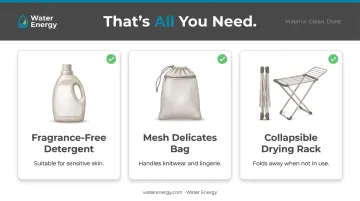
That's it. Everything else is either optional or actively counterproductive.
Consumer Reports explains that fabric softeners deposit residue that reduces towel absorbency and can impair moisture-wicking fabrics. Dryer sheets coat fibers with fragrance chemicals and emit VOCs through residential dryer vents, according to a University of Washington study on dryer vent emissions. Neither product is doing what most people assume it's doing.
Wool dryer balls are a popular alternative, but CHOICE's 2024 testing found no measurable drying time reduction compared to running the same load without them. Skipping both is simpler — and costs nothing.
That pattern — removing products that don't perform — extends to detergent itself. For households ready to go further, an ozone system like Water Energy's Storm eliminates the need for hot water cycles and cuts detergent use by up to 75%, leaving the supply cabinet as bare as the routine.
Frequently Asked Questions
What is the minimalist clothing rule?
Keep only what you regularly wear and love — generally about one week's worth of clothing per person. Every item should earn its place. If something hasn't been worn in a year, it's adding to your laundry load without adding anything useful.
How often should a minimalist do laundry?
Most minimalists run one small load daily or every other day rather than a large weekly session. Consistent small loads take only minutes to finish, and nothing gets forgotten, stained deeper, or soured in the washer.
Is it really okay to wash all clothes in cold water?
Cold water handles the vast majority of household loads effectively with modern detergents. ENERGY STAR notes that roughly 90% of washer energy goes to heating water — so cold washing also cuts utility costs. Ozone systems like the Storm boost cold-water cleaning further for households with higher hygiene needs.
How do you cut down on laundry products?
Start with one fragrance-free detergent used at half the recommended dose. Skip dryer sheets entirely. Eliminate anything that duplicates another product's function. Most households can cut to three items or fewer without any drop in cleaning quality.
What is the fastest way to stop laundry from piling up?
Own fewer clothes so loads stay small, and commit to completing the full cycle — wash, dry, fold, put away — in one session every day or two. Leaving any step unfinished is where piles start.