Introduction
Laundry day in 2026 looks nothing like it did a decade ago. What used to mean tossing clothes in with hot water and hoping for the best has turned into a genuine ecosystem of smart sensors, ozone chemistry, and space-saving engineering.
Rising utility bills, chemical sensitivities, water scarcity, and a lingering post-pandemic obsession with germ-free homes are pushing this shift. Many households now struggle with the same questions: How do I cut my energy bill? Is there a way to get truly clean laundry without harsh chemicals? Will a washer even fit in a 500-square-foot apartment?
This guide breaks down the innovations answering those questions, from ozone and AI technology to compact, health-focused design, so you can upgrade your laundry room before your next utility bill arrives.
Key Takeaways
- Ozone and cold-water systems are replacing hot water and heavy chemical use in more homes
- AI-connected washers now adjust cycles automatically based on fabric and soil level
- Microplastic filters and ultra-efficient machines now cut pollution and utility bills for buyers
- Compact, modular units are solving laundry problems in shrinking urban homes
- Sanitize cycles and hypoallergenic washing are top priorities for health-conscious families
Key Trend 1: Ozone-Infused & Advanced Water Treatment Systems
Dissolved ozone laundry technology works by injecting ozone gas directly into wash water. This is a mass-transfer process where ozone molecules dissolve into water fast enough to sanitize fabric and lift soil without heat or heavy detergent loads.
This isn't experimental lab tech. It's been running in commercial laundries and aerospace applications for decades before making its way into homes.
From Space Shuttles to Home Washers
Water Energy's Storm system traces its roots to a 1990s NASA project. NASA needed a way to clean Space Shuttle Solid Rocket Boosters and their massive recovery parachutes without producing toxic wastewater.
Engineers determined ozone was the only compound that could hit NASA's cleanliness bar without leaving chemical residue behind. That original Tech2Ozone process became the foundation for the Rocket Wash system, and after 25 years of refinement in commercial laundry operations, it now ships as a residential add-on for $399.
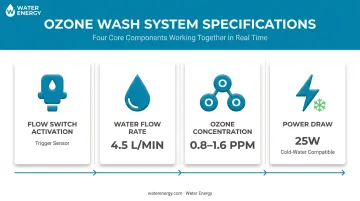
How it works in a home washer:
- A flow switch activates the unit automatically the moment water enters the machine
- Ozone dissolves into water flowing at roughly 4.5 liters per minute
- The system delivers 0.8 to 1.6 parts per million of dissolved ozone
- It runs on just 25 watts and works across a wide pressure and temperature range, including cold water
The Science Behind the Sanitizing Claims
Research on ozone's disinfecting power backs up the appeal. A peer-reviewed study on SARS-CoV-2 found ozone achieved roughly a 0.92 log10 reduction in the virus per unit of ozone exposure in liquid conditions. That level of viral reduction supports ozone's use as a serious sanitization tool, not just a marketing buzzword.
This is exactly why the technology resonates with specific groups:
- Pet owners washing bedding without lingering odor
- Hunters needing scent elimination that won't spook game
- Allergy-prone families trying to cut chemical exposure from fabric softener and detergent residue
One customer in Texas reported her special-needs grandchild's chronic skin rashes disappeared once she stopped washing his clothes with conventional detergent and switched to the Storm system. That's the kind of result driving adoption in sensitive-skin households.
Key Trend 2: AI-Powered & Smart Connected Laundry Systems
WiFi-enabled washers have moved past novelty status. App controls now let you start a cycle from your phone. AI sensors detect fabric type and soil level, adjusting water use and spin speed on the fly.
Real Features Already on the Market
- In-washer faucets built into the drum for targeted pre-treatment of stains
- Automatic detergent dispensing that calculates the right amount based on load size
- Maintenance alerts sent straight to your phone before a small issue becomes an expensive repair
Brands like LG, Samsung, GE, and Whirlpool have all rolled these features into current lineups, with fabric-sensing AI and app-based diagnostics becoming close to standard on mid-to-high-end models.
The Numbers Behind the Trend
Smart appliance adoption isn't a fringe behavior anymore. A 2025 Parks Associates report found that 23% of U.S. internet households owned at least one smart appliance, up from 15% in 2020. That's a substantial jump in just five years.
Why it matters beyond convenience: adaptive cycles reduce water and energy waste by matching machine settings to the actual load, and predictive maintenance alerts help appliances last longer before needing replacement. Fewer wasted cycles and fewer premature breakdowns add up over a machine's lifetime. Pairing a smart washer with an add-on ozone system like the Storm pushes those savings further, cutting water use by up to a third without adding any extra steps to laundry day.
Key Trend 3: Sustainable, Cold-Water & Eco-Conscious Laundry Innovations
Cold-water washing has gone from a fringe eco-choice to a mainstream default setting, and the efficiency numbers explain why.
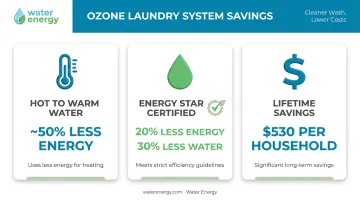
ENERGY STAR notes that about 90% of a washer's operating energy goes toward heating water, and that single fact drives three measurable gains:
- Switching from hot to warm water cuts a load's energy use roughly in half
- Certified washers use about 20% less energy and 30% less water than standard machines
- Households see lifetime savings around $530 per household
Water and energy savings are only part of the sustainability story; filtration technology is closing the loop on pollution too.
Microplastic Filters Are Catching Up to Regulation
Synthetic fabrics shed microfibers with every wash, and filters are now catching a meaningful share of that pollution before it reaches waterways. One peer-reviewed test found a 100-micron external filter captured 89% of discharged microfiber mass under test conditions.
Regulation is following the science. France's AGEC law calls for microfiber filters on new washers starting January 2025, though implementation details are still being finalized. Manufacturers across Europe and North America are adding capture systems ahead of broader mandates.
Where Ozone and Cold Water Meet
This is where the next evolution shows up. Systems like Water Energy's Storm pair ozone injection with cold-water-only operation, cutting chemical use by up to 75% and reducing water use by nearly a third through shortened wash formulas. No hot water heating, no bleach, no fabric softener needed.
Near-waterless washing using polymer bead technology is still mostly a research concept rather than a retail product, but it points toward where water-scarce regions may head next.
Key Trend 4: Space-Saving Design Meets Health-First Hygiene
Two trends are reshaping laundry rooms that have nothing to do with cleaning chemistry: shrinking living spaces and rising hygiene expectations.
Compact, Modular Laundry Solutions
New home sizes are dropping. The National Association of Home Builders reported the median new home fell from 2,200 square feet in 2023 to 2,150 square feet in 2024, the smallest footprint in 15 years. Townhomes now make up 17% of the single-family market, nearly double their 2009 share.
Manufacturers have responded with genuinely useful formats:
- Ventless all-in-one combos like the LG WashCombo and GE Profile UltraFast, which wash and dry in one unit with no external vent required
- Vertical stacked units such as LG's WashTower, combining washer and dryer with one control panel
- Drawer-style pedestal washers like LG's SideKick, adding a second small-load washer under an existing machine
The tradeoff worth knowing: Consumer Reports notes ventless combos usually run longer drying cycles and can't wash a second load while the first dries. Still, for micro-apartment dwellers, the space savings outweigh the wait.
Sanitization Becomes a Standard Feature, Not an Upgrade
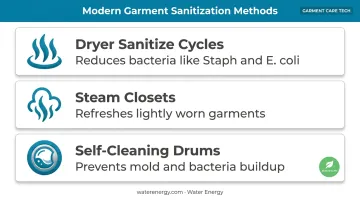
Health-conscious laundry has moved well past "wash your hands" into full garment sanitization:
- Dryer sanitize cycles using extended high heat, with GE citing reductions of common bacteria like Staph and E. coli
- Steam closets, such as LG's Styler, refreshing lightly worn garments between washes
- Self-cleaning washer drums designed to prevent mold and bacteria buildup inside the machine itself
This demand traces back to the same allergy and post-pandemic health concerns fueling ozone adoption. Water Energy's Storm system, for instance, uses ozone rather than heat or bleach to eliminate COVID-19, Staph, and C. difficile from linens in seconds. For households with young kids or chemical sensitivities, that's a compelling alternative to relying purely on high-heat dryer cycles.
What's Driving These Trends & What to Expect Next
Technology, cost pressure, environmental urgency, and health concerns are converging on laundry rooms at the same time. That convergence explains why 2026 feels like a turning point rather than an incremental update.
Technology advances are the clearest driver. AI and IoT connectivity, paired with proven mass-transfer engineering like ozone dissolution, are finally making commercial-grade performance affordable and installable in an average home.
Cost pressure keeps pushing efficiency to the top of buyer priorities. As noted earlier, certified washers already deliver hundreds of dollars in lifetime energy savings, and machines that skip hot water entirely stand to save even more on utility bills.
Environmental and regulatory pressure isn't slowing down either. Water scarcity concerns in drought-prone regions and emerging microplastic filter mandates are forcing manufacturers to build greener designs into every new model line, not just premium tiers.
Watch for these signals over the next one to three years:
- Broader residential adoption of ozone-based systems as awareness spreads beyond early adopters
- AI-driven predictive laundry ecosystems that manage entire households' wash schedules automatically
- Near-waterless washing methods moving from research labs toward limited commercial pilots
Early adopters of these innovations are already seeing lower utility bills and healthier homes, with a shrinking environmental footprint close behind.
Frequently Asked Questions
What are the four types of laundry services?
The four common categories are wash-and-fold service, dry cleaning, self-service laundromats, and pickup-and-delivery laundry. Pickup-delivery often layers onto wash-and-fold or dry cleaning rather than standing alone as a separate cleaning method.
What are the latest innovations in washing machines?
Leading 2026 innovations include AI sensors that detect fabric type and soil level, in-washer faucets for pre-treatment, and ozone-based cold-water sanitization systems. Smart app controls and predictive maintenance alerts are also becoming standard on mid-to-high-end models.
Is ozone laundry technology safe for all fabric types?
Ozone systems work in cold water without harsh chemicals, making them gentle on most everyday and delicate items. Water Energy's Storm extends fabric life by eliminating hot water and chemical residue, though heavily soiled industrial items may still need hot-water treatment.
How much money can smart, eco-friendly laundry technology save annually?
Savings vary by household, but they typically come from reduced hot water use, lower energy bills, and cutting detergent consumption by 70% or more. Check ENERGY STAR's product pages or a manufacturer's specific estimates for numbers that match your setup.
What laundry innovation should I prioritize upgrading in 2026?
Match the upgrade to your biggest pain point. High utility bills call for cold-water, efficient machines; allergies benefit most from ozone or sanitize cycles; and tight living space favors compact, ventless combos.
Do ozone or cold-water wash systems require special detergents?
No special formulation is required. Ozone-based systems like the Storm typically need only a small amount of standard detergent, since the ozone itself handles most of the cleaning and sanitizing work.