Introduction
Walk into a dentist's office, a food processing plant, or a water treatment facility today, and there's a good chance ozone handles the disinfecting. Laundry systems have joined that list too, using dissolved ozone instead of chlorine or synthetic chemicals to sanitize.
For households battling chemical residue, skin irritation, or odors, it offers a chemical-free fix. The growth numbers back this up: the global ozone-generator market is projected to grow from $1,654.2 million in 2026 to $2,570.6 million by 2033, according to Persistence Market Research, reflecting steady demand for ozone-based treatment across industries.
Yet most people encounter the term "ozone rinse" without understanding the mechanism behind it. This guide breaks down exactly what an ozone rinse is, how it works step-by-step, and where you'll find it doing real work.
Key Takeaways
- Ozone rinse is water infused with dissolved ozone gas (O3), a natural oxidizer and antimicrobial
- The process has four stages: generation, dissolution, oxidation, and reversion to oxygen
- Used across dental care, water treatment, food safety, and laundry systems
- Leaves no chemical residue since ozone breaks down back into oxygen after use
What Is an Ozone Rinse?
An ozone rinse is water that's had ozone gas dissolved into it at a controlled concentration. The result is an oxidative solution used for cleaning, disinfecting, or rinsing surfaces and tissue.
Traditional disinfectants like chlorine or alcohol get the job done, but they often leave residue behind or require extensive rinsing afterward. Ozone rinses eliminate that drawback.
According to research published in Comprehensive Reviews in Food Science and Food Safety, ozone dissolves directly into water. This means the liquid itself carries the disinfecting power to a surface, rather than relying on a dry gas application.
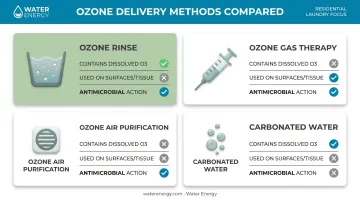
What an Ozone Rinse Is Not
It's easy to lump ozone applications together, but they're not interchangeable:
- Ozone gas therapy applies ozone gas directly to tissue, often in clinical settings
- Ozone air purification releases gaseous ozone into ambient air to treat airborne contaminants
- Plain carbonated or aerated water contains no ozone at all and carries none of its oxidative properties
Only dissolved ozone in water counts as an ozone rinse.
Why It's Still Relevant
Chemical alternatives work, but they come with tradeoffs: lingering taste, residue, and the need for careful storage and disposal. Ozone rinses skip all of that. They act fast against bacteria, viruses, and biofilm, and once the reaction finishes, ozone simply reverts to oxygen. No aftertaste, no toxic buildup.
You'll find ozone rinses adapted across several settings:
- Oral rinses for gum health and bacteria reduction
- Industrial rinse water in food processing and water treatment
- Laundry rinse cycles, such as those built into residential ozone laundry systems, sanitize fabric using only cold water
The underlying chemistry stays the same in every case. What changes is the concentration and how it's delivered.
How Does an Ozone Rinse Work?
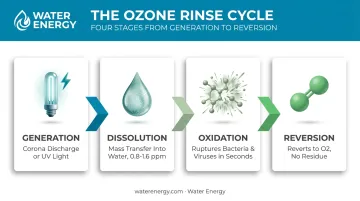
An ozone rinse follows a defined sequence every time: generation, dissolution into water, oxidative action against contaminants, and safe reversion back to oxygen. Each stage matters, and weak performance at any point affects the final result.
Generation and Initiation
Ozone doesn't sit in storage waiting to be used. It's unstable, so systems generate it on demand.
Two common methods exist:
- Corona discharge, where high-voltage electricity passes through a dielectric gap, splitting O2 molecules so oxygen atoms recombine into O3
- UV generation, where vacuum-UV light near 185 nm photodissociates oxygen molecules, producing the same O3 result
In most rinse systems, generation is automated and condition-based. The generator activates only when water flow begins, which limits unstable or excess ozone production.
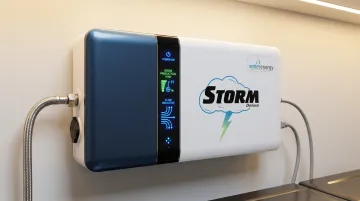
Water Energy's Storm system illustrates this well. A built-in flow switch triggers ozone production the moment water starts moving through the unit, and shuts it off when flow stops. No manual activation required.
Poor water quality or generator wear can cause inconsistent ozone output, directly weakening disinfection reliability downstream.
Core Operation: Dissolving Ozone Into Water
Generating ozone gas is only half the job. For it to disinfect anything, it has to transfer into the water itself, a process called mass transfer.
Once dissolved, ozone molecules make direct contact with bacterial cell walls, viral envelopes, and organic residue. The reaction is fast — ozone oxidizes and ruptures these structures within seconds, neutralizing pathogens almost immediately on contact.
This stage is where performance variables come into play:
- Contact time: longer exposure generally improves results
- Dissolved ozone concentration — higher concentration means faster oxidation, within safe limits
- Water temperature affects retention, since colder water holds dissolved ozone more effectively than warm water
Water Energy's Tech2Ozone process, originally engineered for NASA's Space Shuttle program, was built specifically to solve this mass transfer challenge at scale. That same dissolution principle now runs inside the Storm's residential wash cycles.
Regulation and Control
Effective systems maintain a stable dissolved ozone concentration, commonly cited in the 0.8–1.6 ppm range, despite fluctuations in water flow or temperature.
Sensors and flow controls exist to prevent two failure modes: under-dosing, which leaves disinfection incomplete, and over-dosing, which raises safety concerns without adding benefit.
The Storm system handles this through its flow switch and digital control panel, which displays power status, ozone production level, and a flow indicator in real time. Users don't calibrate anything manually. The system self-regulates within its engineered range every time water flows through it.
Inconsistent control at this stage is a real risk. Without it, you either get weaker antimicrobial performance or unnecessary ozone exposure, neither of which is acceptable in a rinse system meant to run unattended.
Output and Result
Once oxidation completes, the ozone has done its job: bacteria, viruses, biofilm, or chemical residues get neutralized. Ozone then naturally reverts back into oxygen and water, leaving no harmful byproduct behind.
This clean output feeds directly into whatever comes next, whether that's a disinfected mouth environment, sanitized produce headed to packaging, or fabric that's free of chemical buildup.
The efficacy numbers back this up. A USDA Agricultural Research Service study continuously applied dissolved ozone to water treating inoculated alfalfa seed for 20 minutes at 4°C, recording a 1.48-log10 CFU/g reduction, equivalent to a 97% decrease in Listeria monocytogenes.
Ozone alone didn't achieve complete elimination in this trial, a reminder that results depend heavily on contact time and application conditions.
Where Is an Ozone Rinse Used?
The same core chemistry shows up in wildly different settings. Here's where ozone rinses are doing real work right now.
Dental and Oral Care
Ozone rinses appear both chairside and at home to support gum health and reduce oral bacteria. They're also used to aid healing after procedures like extractions or deep cleanings, often as a complement to standard care rather than a replacement for it.
Water and Wastewater Treatment
Ozone serves as a disinfection stage in treatment plants, inactivating pathogens before water is discharged or reused. Because ozone leaves no persistent chemical residue, it fits well into systems designed to minimize downstream chemical load.
Commercial and Residential Laundry
Ozone rinse technology has moved into wash cycles, killing bacteria and viruses directly in cold water. Water Energy adapted the same NASA-derived mass transfer process, originally engineered to clean Space Shuttle Solid Rocket Boosters and parachutes without producing toxic wastewater. That technology now powers its residential and light commercial laundry system, the Storm.
The Storm delivers 0.8–1.6 ppm of dissolved ozone directly into the wash water, which:
- Kills bacteria, viruses, and spores on linen in seconds
- Cuts chemical use by roughly 75%
- Reduces water use by up to a third
Food and Produce Washing
Ozone rinses reduce pathogen loads on fresh produce without leaving pesticide or chemical residue behind. This use is permitted under FDA regulation 21 CFR 173.368, which allows ozone in aqueous and gaseous phases as an antimicrobial agent in food processing.
Benefits and Safety Considerations of Ozone Rinse
Ozone rinses offer broad-spectrum antimicrobial action against bacteria, viruses, and even resistant spores, without the harsh chemicals found in traditional rinses. Because ozone converts back into oxygen after reacting, there's no lingering chemical buildup on fabrics, linens, or surfaces.
That said, safety depends entirely on staying within regulated concentration ranges. High-concentration ozone gas exposure can cause respiratory irritation, which is why automated, calibrated systems matter far more than manual dosing.
Professional-grade systems reduce that risk through:
- Automatic flow control that ties ozone production directly to water flow
- Real-time digital monitoring showing production level and system status
- Certified manufacturing standards, such as CE RoHS compliance and ISO 9001:2015 factory certification
The Storm system reflects this design philosophy:
- Requires no manual calibration and runs maintenance-free
- Manages ozone levels automatically through a built-in flow switch and digital readout
- Backs consistent performance with a 1-year warranty
- Eliminates the need for users to add chemicals or monitor output
Conclusion
An ozone rinse works through a consistent logic: generate ozone on demand, then dissolve it into water. The dissolved ozone oxidizes contaminants on contact, then reverts safely back to oxygen. That sequence is what makes chemical-free disinfection possible, whether it's happening in a dentist's chair, a water treatment plant, or a washing machine.
Understanding that mechanism helps when evaluating any ozone-based system, including a residential laundry solution like the Storm, which applies the same NASA-proven mass transfer technology to everyday washing.
Frequently Asked Questions
What is ozone mouthwash?
Ozone mouthwash is water infused with dissolved ozone gas, used as a rinse to reduce oral bacteria, support gum health, and freshen breath without alcohol or harsh chemicals.
Is ozone good for your teeth?
Ozone can help reduce harmful oral bacteria and support gum tissue healing. It should complement, not replace, regular dental care and professional cleanings.
Is it safe to drink ozonated water every day?
Ozonated water is generally considered safe at low, controlled concentrations for occasional use. Check with a healthcare provider before making it a daily, long-term habit.
How is an ozone rinse different from ozone gas therapy?
An ozone rinse uses ozone dissolved in water for surface or tissue contact. Ozone gas therapy applies ozone gas directly, often for more targeted clinical treatments.
Does using an ozone rinse have any side effects?
Properly diluted ozone rinses are generally well-tolerated. Improperly concentrated ozone gas exposure can cause irritation, so calibrated systems control concentration levels to prevent this risk.
Can ozone rinse technology be used outside of dental care?
Yes. The same mass transfer principle behind dental ozone rinses also powers water treatment and food safety washing. Water Energy's Storm laundry system applies this technology to disinfect fabric in cold water, cutting chemical use by up to 75%.