The answers online are all over the place. Some sites push whole-room ozone machines as a mold cure. Others, including the EPA, warn that ozone generators can be dangerous and often don't work as advertised.
Here's the truth: it depends entirely on how the ozone is applied. This article breaks down the science, separates gaseous ozone treatments from dissolved ozone used in laundry systems, and gives you a straight answer for mold and mildew on fabric.
Key Takeaways
- Ozone destroys mold spores through oxidation, but delivery method (air vs. water) determines safety and effectiveness.
- Whole-room gaseous ozone can't penetrate porous materials like drywall and carries real health risks.
- Dissolved ozone saturates fabric fibers directly, killing mold, mildew, and odor-causing bacteria with no chemical residue.
- Water Energy's Storm system applies this dissolved-ozone process to residential laundry, using technology developed with NASA.
What Is Ozone and How Does It Actually Kill Mold?
Ozone (O3) is oxygen's unstable cousin. It has three oxygen atoms instead of two, and that third atom is desperate to bond with something else. This instability is exactly what makes ozone such an aggressive oxidizer.
When ozone contacts a mold spore, it attacks the cell wall and membrane. Research published in Water Research found that ozone attacks fungal spores like Aspergillus niger and Penicillium polonicum in two stages.
Rapid initial damage occurs within about 30 seconds, followed by a slower breakdown as intracellular material leaks out (Wen et al., 2020). Once the wall ruptures, the spore is no longer viable.
Contact Is Non-Negotiable
Here's the catch that a lot of marketing conveniently skips: ozone has to physically touch the spore to kill it.
Gas molecules bouncing around a room don't automatically find every spore hiding in carpet padding or embedded in drywall. No contact means no kill. This single fact explains most of the disagreement you'll find online about ozone's effectiveness.
Killing Isn't the Same as Removing
Even when ozone does make contact and kills a spore, that's not the end of the story:
- Dead mold biomass can still cause allergic reactions, according to the EPA
- Staining from mold growth typically remains after the organism is dead
- Mycotoxin residue is a separate chemical issue that ozone alone doesn't reliably resolve
Achieving that kill in the first place depends on getting concentration and exposure time right, and both vary wildly by context:
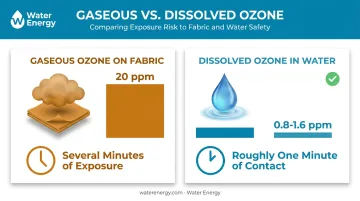
- Gaseous ozone on fabric: lab studies used concentrations around 20 ppm for several minutes to inactivate spores on swatches
- Dissolved ozone in water: studies showed strong spore inactivation within roughly a minute of contact in suspension, though effectiveness dropped sharply against spores stuck to rough surfaces
There's no single "magic number" that applies across every scenario.
Room Ozone Treatments vs. Dissolved Ozone in Laundry: Why Application Matters
This is where most of the confusion clears up. "Ozone" isn't one product with one behavior. How it's delivered changes everything.
The Problem With Whole-Room Ozone
Ambient ozone generators are marketed heavily for mold remediation in homes and buildings. The health-risk math doesn't support that use case.
OSHA's workplace exposure limit is 0.1 ppm as an 8-hour average (OSHA Chemical Data). Yet the EPA notes that biological decontamination often requires concentrations 5 to 10 times higher than public-health standards allow.
That's the safety-efficacy trap: levels safe enough to breathe usually aren't strong enough to work, and levels strong enough to work usually aren't safe to breathe.
The professional restoration industry has largely caught up with this reality. The current mold remediation standard, ANSI/IICRC S520-2024, addresses ozone directly in its section on antimicrobial devices and places less emphasis on biocide use overall.
Industry group SCRT quotes the standard directly: ozone "as a substitute for removal and detailed cleaning is generally not recommended."
High-concentration gaseous ozone also has a side effect nobody mentions in the sales pitch: it accelerates deterioration of rubber and plastic components. That's a real concern for anything left in a treated room during extended sessions.
Porous Materials Are the Real Blocker
Even setting safety aside, gaseous ozone runs into a physical wall. It can't reach mold growing inside drywall, carpet padding, or wood framing.
The EPA specifically notes that high ozone concentrations may have no effect on biological contaminants embedded in porous materials like duct lining and ceiling tiles. If mold has burrowed into a porous surface, the gas simply never touches it. This is exactly why remediation professionals still prioritize physical removal over ozone gas alone.
Why Dissolved Ozone Works Differently
Dissolved ozone flips the whole equation. Instead of relying on gas to drift through air and hope it finds a spore, ozone gets mass-transferred directly into water. That water then:
- Fully saturates fabric fibers during a wash cycle
- Makes direct physical contact with spores throughout the fabric, not just on the surface
- Operates at low, controlled concentrations, typically in the 0.8–1.6 ppm range
- Reverts to plain oxygen shortly after use, leaving zero chemical residue
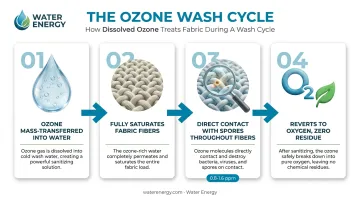
Because the ozone is dissolved rather than airborne, you get the oxidizing power without the breathing hazard.
Does Ozone Kill Mold and Mildew on Clothes, Towels, and Linens?
Yes. When ozone is dissolved into wash water, it kills mold spores, mildew, and the bacteria responsible for that persistent musty smell on fabric.
Here's what happens during the cycle: ozonated water penetrates deep into fibers, not just the surface. It oxidizes spore cell walls on contact and breaks down odor-causing molecules at their source, rather than covering them up with fragrance the way most detergents do.
How Fast Does It Work?
Speed is one of dissolved ozone's biggest advantages over gaseous treatments. Water Energy documents its Storm system eliminating spores, bacteria, and viruses on linens within seconds of contact during a normal wash cycle.
Compare that to gaseous room treatments, which often need hours of exposure at concentrations that exceed safe breathing limits.
What About Permanent Removal?
Ozone kills active spores and destroys odor during the wash. It does not, by itself, guarantee mold never returns. Regrowth depends on what happens after the wash:
- Dry items completely before storing them
- Avoid low-airflow storage like sealed gym bags or damp hampers
- Wash mold-prone items promptly rather than letting them sit wet
Skip these steps and spores from the environment can recolonize damp fabric, ozone treatment or not.
Where This Matters Most
Black mold and mildew show up constantly on:
- Gym clothes left in closed bags
- Towels that never fully dry between uses
- Cloth diapers stored in sealed pails
Water Energy's Storm system, built on dissolved-ozone technology the company originally developed for NASA's Space Shuttle Program in the 1990s, targets exactly this kind of fabric contamination. NASA needed a way to clean Solid Rocket Booster parachutes to an extreme standard without generating toxic wastewater.
Ozone was the only compound that met the requirement, since it cleans aggressively and then simply reverts to oxygen. That same mass-transfer process, refined over 25 years in commercial laundry, now runs in residential units.
Ozone vs. Hot Water and Bleach
Traditional mold laundering leans on hot water and bleach. It works, but it's hard on fabric and requires harsh chemicals.
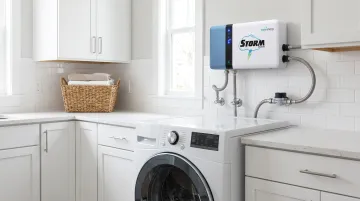
Dissolved ozone achieves disinfection-level cleanliness in cold water, without the chemical load. The Storm system's automatic flow control delivers ozone through a flow switch that activates only when water is moving, keeping concentration steady at 0.8–1.6 mg/L throughout the cycle.
Is Ozone Safe to Use Against Mold?
The short answer: it depends entirely on whether you're breathing it or washing in it.
Gaseous ozone at concentrations strong enough to affect mold indoors reliably exceeds safe breathing limits. The EPA states plainly that ozone applied to indoor air at levels within public-health standards does not effectively remove mold, bacteria, or viruses.
California's air regulator (CARB) goes further, recommending against ozone generators for anything other than approved industrial uses with strict exposure controls.
Dissolved ozone laundry systems sidestep this problem entirely. Because the ozone stays in the water rather than filling the room, there's no comparable inhalation risk. Systems like the Storm use automatic flow control (a flow switch tied to water movement) to keep concentrations self-regulated at 0.8–1.6 mg/L, well below levels that pose airborne risk.
Practical rule of thumb:
- Avoid unsupervised, high-output ozone generators in occupied living spaces
- Favor purpose-built, certified dissolved-ozone equipment for laundry applications
- Never assume a room deodorizer and a laundry ozone system work the same way
Using Ozone the Right Way for Mold-Free, Fresh Laundry
Getting real value from ozone starts before the wash cycle even begins.
Address moisture first. Wash mold-affected items promptly instead of letting them sit damp in a hamper or gym bag. Spores take deeper hold the longer fabric stays wet, and no laundry treatment fully compensates for chronic dampness.
Water Energy's Storm system builds on this foundation with dissolved-ozone technology engineered originally for NASA and refined across 25 years of commercial laundry use. It delivers 0.8–1.6 ppm of dissolved ozone into the washer to kill mold, mildew, bacteria, and viruses on linens, all in cold water.
For households dealing with mold-prone laundry, the practical upside extends beyond disinfection:
- Families and pet owners get odor elimination without stacking on more detergent
- Hunters benefit from scent elimination on gear that regular washing doesn't fully deodorize
- Sensitive skin households see fewer chemical residues, since the system cuts chemical use by roughly 75%
- Everyone gets softer fabrics and longer garment life from skipping hot water and harsh detergent
Ownership is just as straightforward as the wash cycle itself:
- Installs in about 30 minutes with no plumber required
- Runs maintenance-free, with no filters or servicing to schedule
- Backed by a 1-year warranty, CE RoHS certification, and ISO 9001:2015 manufacturing standards
Frequently Asked Questions
How long does it take ozone to kill mold on clothes?
Dissolved ozone acts on contact, working within the timeframe of a normal wash cycle, often within seconds of exposure. Gaseous ozone treatments, by contrast, typically require much longer exposure at concentrations that exceed safe breathing limits.
Can ozone permanently remove mold from clothes?
Ozone kills active spores and odor during washing, but it doesn't prevent future growth on its own. Permanent prevention depends on drying items completely and storing them in a low-moisture environment afterward.
Will ozone ruin clothes?
Low-concentration dissolved ozone used in laundry systems is fabric-safe and actually reduces wear by eliminating hot water and harsh chemicals. High-concentration gaseous ozone, used improperly, can degrade materials like rubber and certain dyes.
What do professionals use to kill black mold on clothes?
Professionals usually combine proper cleaning agents with hot or ozonated cold-water washing, followed by thorough drying. Gaseous ozone alone is not considered a substitute for removal and detailed cleaning under current restoration standards.
Is ozone safe to breathe during a laundry ozone treatment?
Dissolved ozone laundry systems operate at low, engineered concentrations (around 0.8–1.6 ppm in the water) that are safe for home use. This differs from ambient air ozone generators, which can raise room concentrations to unsafe levels.
Does ozone kill mold inside the washing machine itself?
Yes. Ozonated water flows through the same inlet as regular wash water, contacting the drum interior and door seals along the way. This helps oxidize mold and mildew buildup that commonly causes musty odors in HE washers.