Traditional laundering also has a ceiling. You can only turn up the heat and add more bleach so much before you're burning cash without meaningfully improving hygiene. One documented hotel retrofit cut annual operating costs by roughly 38%, with the investment paying for itself in under eight months.
Ozone laundry technology, engineered originally for NASA's Space Shuttle program, gives commercial operators a way to break that ceiling: disinfecting more effectively while using less hot water, less chemistry, and less energy.
Key Takeaways
- Dissolved ozone cuts reliance on hot water and heavy chemical loads
- Case studies show 38-40% operational savings, with paybacks often under eight months
- Facilities report lower water, gas, and electricity use alongside longer fabric life
- Water Energy's Tech2Ozone process, born from a NASA challenge, reflects 25 years of refinement
What Is a Commercial Ozone Laundry System and How Does It Work?
A commercial ozone laundry system pumps ozone gas (O3) into wash water instead of relying purely on heat and detergent to clean linens. Ozone is one of the most powerful oxidizers available. It breaks apart the molecular bonds of organic soil, oils, and body residue, and it kills bacteria and viruses on contact.
Once it finishes the job, dissolved ozone reverts back to oxygen (O2). No chemical residue stays behind in the fabric or the wastewater, unlike chlorine bleach or synthetic detergents.
Core System Components
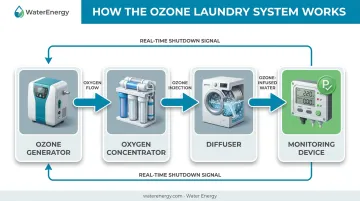
A typical setup includes:
- Ozone generator – produces ozone gas from ambient air or concentrated oxygen
- Oxygen concentrator – feeds purified oxygen to boost generation efficiency
- Diffuser – installed directly in the washer sump, dissolving ozone into wash water
- Monitoring device – tracks dissolved ozone concentration in real time and can shut down generation if levels drift
From a NASA Parachute Problem to the Laundry Room
The mass-transfer technology behind ozone laundering has an unusual origin. In the 1990s, NASA needed a way to clean Space Shuttle Solid Rocket Booster parachutes without creating toxic chemical wastewater. Engineers working the problem landed on ozone as the only compound capable of hitting NASA's cleanliness bar without leaving residue behind.
That work became the Tech2Ozone process, the foundation Water Energy has spent 25 years refining specifically for laundry applications.
There's no single industry-wide ppm standard for dissolved ozone in commercial installations. Documented commercial tests have used concentrations as low as 0.2-0.6 ppm at the wash wheel, while manufacturer specifications elsewhere call for 1.5-3.0 ppm.
What matters more than the number on a generator's spec sheet is the concentration actually measured at the wash wheel. That's the figure operators should verify during commissioning, not the marketing claim on a brochure.
Key Benefits of Ozone Laundry for Commercial Operations
Ozone laundering delivers measurable gains across nearly every cost line a laundry manager tracks:
- Lower utility bills – Eliminating or shrinking hot-water wash cycles cuts natural gas and electricity use, with field installations showing reductions ranging from 63% to as high as 91%.
- Less water overall – Shorter wash formulas and fewer rinses can trim total water use, though results depend on how the washer is reprogrammed: one hotel property saw a 15% cut, while a lower-volume site saw usage rise.
- Far less chemical use – The dissolved-ozone process Water Energy refined over 25 years in commercial laundries cuts chemical use by up to 75%, since ozone handles much of the oxidizing work detergent alone used to do.
- More loads per day – Shorter wash and dry cycles mean facilities can push more loads through the same equipment without adding staff or overtime hours.
- Longer fabric and equipment life – Removing hot water and harsh chemical residue reduces fiber breakdown, shortens drying time, and stretches the useful life of linens.
Disinfection Claims Deserve a Careful Read
Ozone's disinfection power is real, but vendor claims deserve scrutiny. Neither the EPA nor the CDC has published a blanket disinfection-efficacy rating for ozone laundering; their guidance covers conventional hygienic laundering methods instead.
Independent technical trials on dissolved ozone have documented meaningful reductions in organisms like MRSA, E. coli, and even C. difficile spores, but results depend heavily on concentration, contact time, and equipment design. Ask for facility-specific testing data before assuming a blanket claim applies to your operation.
Real-World Proof: Commercial Ozone Laundry Case Studies
Case studies bring these numbers down to earth. Two properties, in particular, show what ozone laundering can do when measured against a real baseline.
Apple Farm Inn: 38% Cost Savings in a Side-by-Side Test
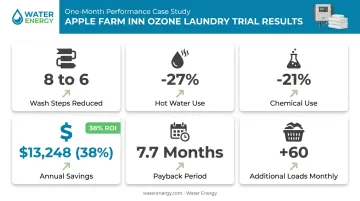
At the 104-room Apple Farm Inn & Suites in San Luis Obispo, operators ran a direct one-month comparison: traditional washing against a ClearWater Tech EcoTex ozone system processing roughly 1,600 pounds of linen per day.
The results, as reported by Compressed Air Best Practices:
- Wash formula dropped from eight steps to six
- Hot water use fell 27% per load
- Chemical use dropped 21%
- Annual operating costs fell about 38%, roughly $13,248 in direct savings
- Payback landed at 7.7 months once labor savings were included
- The property processed nearly 60 additional loads per month with no new staff
Westin Hotel, Palo Alto: A Documented Utility Retrofit
A retrofit of three commercial washers at the Westin Hotel in Palo Alto shows similar results on the utility side. According to the City of Palo Alto's case study, the $33,128 project delivered:
- Annual natural gas use cut by 16,400 therms
- Electricity use cut by 7,400 kWh
- Water use cut by more than 1.6 million gallons a year, a 91% drop in hot water use alone
- Annual greenhouse gas emissions reduced by 91.8 metric tons
Combined utility incentives totaled $25,316, bringing simple payback down to about four months.
Healthcare and Shelter Facilities Are Paying Attention
Facilities beyond hospitality are watching closely too. Resources like UC Davis's Koret Shelter Medicine Program now evaluate ozone laundry systems for infection control in high-turnover linen environments, where bedding and towels cycle constantly and disinfection failures spread disease fast.
This growing interest across sectors builds on the same dissolved-ozone science Water Energy has spent 25 years refining. It started with a NASA challenge to eliminate toxic wastewater from cleaning Space Shuttle parts, and continues today in ozone laundry systems built for smaller-scale commercial and residential use.
Ozone Laundry vs. Traditional Laundry: Quick Comparison
Traditional and ozone laundry systems aim for the same outcome: clean, disinfected linens. They just get there differently.
| Factor | Traditional Laundry | Ozone Laundry |
|---|---|---|
| Wash temperature | Around 140°F | Mostly cold water; warm cycles reserved for heavily soiled loads |
| Chemical usage | Full detergent, bleach, and softener stages | Reduced up to 75%, per Water Energy's benchmarks |
| Cycle time | Baseline | Often 20-40% shorter, with some steps removed entirely |
| Water usage | Baseline | Varies by facility; some sites see double-digit reductions, others little change |
| Disinfection | Relies on heat, time, and chemistry | Oxidizes pathogens at the molecular level, even in cold water |
Ozone systems also tend to eliminate entire wash steps. Instead of separate extract, detergent, and bleach stages, some facilities combine steps into one shorter formula. That's exactly what let Apple Farm Inn, one of Water Energy's documented case studies, cut its wash cycle from eight steps to six.
These efficiency gains also lower operating costs. The upfront investment is real, but it rarely takes long to pay off. Water Energy's published case studies show payback windows ranging from about four months to under eight, depending on facility size and available utility rebates.
Is Ozone Laundry Safe? Addressing Common Concerns
Some facility managers hesitate at the word "ozone" because ambient ozone gas is a known respiratory irritant. Dissolved ozone in wash water works differently.
Because it's injected directly into the washer sump and dissolves into the water, it reverts to oxygen before it reaches the air workers breathe, as long as the system is properly sized and maintained. That's a very different exposure profile than gaseous ozone in an open room.
Exposure Limits Worth Knowing
Regulatory limits exist for airborne ozone, not dissolved ozone in wash water. OSHA sets a permissible exposure limit of 0.1 ppm averaged over an 8-hour shift, and NIOSH recommends that same 0.1 ppm as a ceiling that should never be exceeded at any point.
Well-designed commercial systems use ambient air monitors near the washers, tied to automatic shutdown, to keep exposure inside these thresholds.
Built-In Safety Engineering
Certified systems reduce operator risk further through automatic controls. Water Energy's Storm systems, built on 25 years of commercial ozone experience, carry CE RoHS and ISO 9001:2015 certification and use automatic flow control that activates ozone generation only when water is flowing, cutting production the instant a cycle ends.
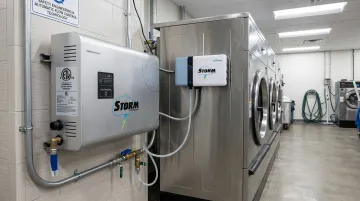
That kind of engineered fail-safe, paired with routine sensor calibration, keeps dissolved ozone systems operating well within recognized safety limits.
Frequently Asked Questions
Does ozone laundry really work?
Yes. Documented commercial case studies show measurable reductions in utility costs, chemical use, and wash cycle time, backed by decades of industrial and hospitality use.
What does ozone do in laundry?
Dissolved ozone oxidizes soil and oils on fabric and kills bacteria and viruses on contact. It then reverts to oxygen, leaving no chemical residue behind.
How harmful is ozone to humans?
Dissolved ozone in wash water poses minimal risk when systems are properly sized and monitored within recognized thresholds like OSHA's 0.1 ppm limit. Airborne exposure is the real concern, not dissolved ozone in water.
How much does a commercial ozone laundry system cost?
Costs vary based on facility size, washer capacity, and the diffuser and monitoring equipment required for safe ozone delivery. Most facilities offset this investment quickly through reduced hot water, chemical, and labor costs.
Can ozone laundry systems work with existing commercial washers?
Most ozone systems retrofit onto existing washers using a diffuser installed directly in the washer sump, without requiring new equipment.
How long does it take to see ROI on an ozone laundry system?
Documented paybacks typically range from four to eight months, depending on facility size, utility rebates, and how much hot water and chemical use the system displaces.