Introduction
For more than a century, water utilities have pumped ozone gas into treatment tanks to kill pathogens before that water ever reaches a tap. Ozone itself forms naturally when UV light or an electrical spark splits an oxygen molecule apart, forcing a third atom onto it.
Today, ozone disinfects far beyond water plants. It's used in hospital rooms, hotel linens, and even home laundry systems, with the World Health Organization recognizing it as a primary drinking-water disinfectant.
Here's the disconnect: most people using ozone equipment don't know how it kills anything. They know it's "chemical-free," but concentration, contact time, and mixing method determine whether ozone actually works, or just doesn't. Get those variables wrong, and you either under-treat or create a safety risk.
This guide breaks down exactly how ozone disinfection works, stage by stage.
Key Takeaways
- Ozone (O3) oxidizes contaminants, then reverts naturally to oxygen with zero residue.
- The process follows four stages: generation, contact, oxidative kill, and reversion.
- Applications span drinking water, wastewater, air, surfaces, food processing, and laundry.
- Effectiveness hinges on concentration (ppm) and contact time, not exposure alone.
What Is Ozone Disinfection?
Ozone disinfection uses O3, either as a gas or dissolved in water, to oxidize and destroy bacteria, viruses, mold spores, and other pathogens on contact. Instead of coating a surface with a chemical film, ozone attacks a pathogen's cell wall or protein structure directly, then breaks back down into oxygen.
Why it fills a gap traditional chemicals can't:
- Chlorine and bleach leave residues and can form disinfection byproducts
- Liquid chemicals struggle to reach concealed surfaces, fabric folds, or enclosed air spaces
- Ozone gas penetrates those areas, then decomposes cleanly with nothing left behind
What ozone disinfection is not:
- Ozone therapy is a distinct medical practice involving controlled exposure in clinical settings, not this process
- Ionization relies on charged particles rather than oxidation to neutralize contaminants
- Air fresheners mask odors with fragrance; ozone destroys the organic compounds causing the smell
Despite newer options like UV-C entering the market, ozone stays popular because it treats air and surfaces simultaneously, and because it's fast.
According to EPA's disinfection benchmarking data, achieving 3-log Giardia inactivation at 5°C requires a CT value of just 1.90 mg-minutes/L with ozone. Free chlorine needs 149 mg-minutes/L to hit that same benchmark, roughly 78 times more under those specific conditions.
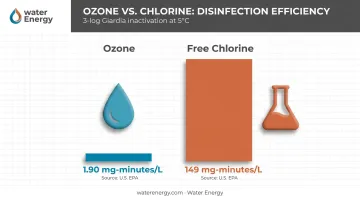
That speed shows up in two distinct application types:
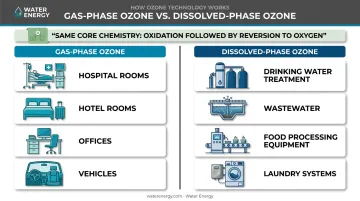
- Gas-phase ozone – airborne O3 used for disinfecting air and exposed surfaces in enclosed spaces like hospital rooms or vehicles
- Dissolved (aqueous) ozone – ozone gas mass-transferred into water, used in drinking water treatment, industrial sanitation, and laundry systems
The dissolution step for aqueous ozone is where a lot of potential gets lost if the underlying engineering isn't dialed in. Water Energy's team first tackled that challenge decades ago while designing ozone-based cleaning systems for NASA's Space Shuttle Program.
How Does Ozone Disinfection Work?
Ozone disinfection unfolds through a defined sequence, not a single spray-and-done action: generation, dissolution and contact, oxidative destruction, and reversion to oxygen. Each stage determines whether the final result actually kills pathogens or just changes how the air smells.
Initiation
Ozone generation begins one of two ways:
- Corona discharge passes 6,000–20,000 volts of alternating current across a gap, splitting O2 molecules that recombine into O3. This is the standard industrial method.
- UV generation uses wavelengths below 240 nm to achieve a similar split, though output is typically less concentrated.
Once the generator is powered on, initiation runs largely on its own. Air or oxygen feeds continuously through the unit, and ozone comes out the other side without manual intervention.
The catch: feed air has to be dry. Moisture drops ozone yield significantly and can allow corrosive nitric acid to form inside the generator. This is why air preparation, not just the generator itself, becomes an operational dependency that basic systems sometimes overlook.
Core Operation
Ozone's third oxygen atom is only loosely attached to the molecule. That instability is what makes it such an effective disinfectant: the loose atom readily transfers onto any organic material it touches, whether that's a bacterial cell wall or an organic stain on fabric.
But that reaction only happens on contact. Ozone must physically diffuse into air or water and meet the microorganism before oxidation occurs:
- Bubble diffusers push ozone gas through water in fine bubbles to maximize surface contact
- Venturi injectors create a vacuum that pulls ozone gas into a water stream as it passes through a constriction
Poor mixing means ozone escapes without ever touching the target. Good mixing sustains usable concentration.
Kill rate ultimately comes down to two variables working together: concentration (ppm) and contact time. High concentration for too short a time, or low concentration for too long, and results suffer either way.
Water Energy's engineers faced this exact problem decades before residential ozone laundry existed. NASA needed Solid Rocket Booster parachutes cleaned in the 1990s without generating toxic wastewater, and simply adding more ozone gas wouldn't solve it.
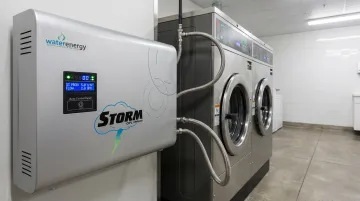
The engineers instead built a mass-transfer process, later named TecH2Ozone, that dissolved ozone into water far more consistently than a basic generator could manage. That same dissolution principle now runs inside Water Energy's Storm systems, delivering 0.8 to 1.6 ppm of dissolved ozone directly into the wash water.
Regulation and Control
Ozone systems need feedback to stay both effective and safe. Municipal and industrial setups typically rely on ORP monitors or dedicated ozone sensors to track concentration and adjust generator output automatically.
That feedback matters because there's no forgiving middle ground:
- Under-dosing fails to reach the concentration and contact time needed to kill pathogens
- Over-dosing creates safety hazards and can degrade sensitive materials
Rooms aren't airtight, and water chemistry shifts with temperature and organic load. Without some form of control, treatment time and results turn into a guessing game.
Not every system needs complex, adaptive sensors to stay consistent, though. Water Energy's Storm systems use a flow switch that activates ozone production the moment water starts flowing and shuts it off when flow stops.
A digital readout tracks production level, flow status, and leak detection in real time. Because the dissolution process holds a tight, pre-calibrated output range, the system doesn't need to recalculate dosing the way a variable municipal source might.
Output and Result
When the process works as engineered, the outcome is simple: pathogens destroyed, ozone gone, nothing left behind. The third oxygen atom that made ozone so reactive has already transferred to whatever it destroyed, and the molecule has settled back into plain O2.
Properly calibrated systems achieve measurable reductions described in "log" terms:
- 2-log reduction = 99% of pathogens eliminated
- 3-log reduction = 99.9% eliminated
- 4-log reduction = 99.99% eliminated
What happens next depends on the application. Water moves on to filtration or distribution. Rooms get aired out before reoccupation. Fabric goes straight into rinse or dry cycles with no chemical buildup to remove.
That last point is where dissolved-ozone laundry systems differ most from chemical washing. Because Water Energy's Storm systems leave zero chemical residue on treated linens, towels come out noticeably softer, and drying times shrink since there's no chemical film holding onto moisture in the fibers.
Where Is Ozone Disinfection Used?
Ozone shows up anywhere pathogens need to go without leaving a chemical trail behind.
Water treatment Municipal drinking water plants inject ozone before or alongside filtration to oxidize contaminants and pathogens. Wastewater treatment and pool sanitation use similar injection points, often supplementing a required halogen residual rather than replacing it entirely.
Air and surface disinfection Ozone performs best in enclosed, sealable spaces needing fast turnaround between occupants:
- Hospital rooms and medical equipment
- Hotel rooms between guests
- Offices after hours
- Vehicles between rentals
These environments allow high-concentration treatment cycles without anyone breathing the gas mid-treatment, followed by airing out before reentry.
Industrial and laundry applications Food and beverage manufacturers use ozone to sanitize processing equipment in gas or aqueous form. Commercial laundry operations have used dissolved ozone for decades to cut hot water and detergent use while still meeting sanitation standards.
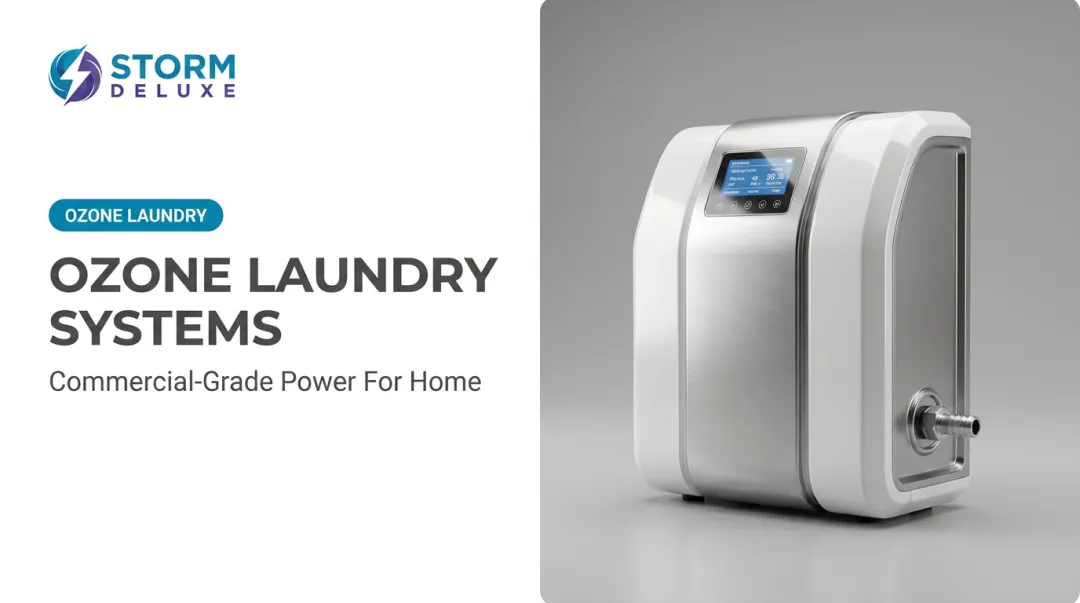
Water Energy has run this exact dissolved-ozone approach in commercial laundry for 25 years before adapting it for residential and light commercial use through the Storm Deluxe and Storm OPL Deluxe systems.
Instead of hot water and heavy detergent doing the sanitizing work, dissolved ozone handles it in cold water, cutting chemical use by up to 75%.
Gas-phase ozone dominates air and surface applications. Dissolved-phase ozone dominates water and laundry applications. Contact time and temperature shift by industry, but the underlying chemistry, oxidation followed by reversion to oxygen, stays the same.
Conclusion
Ozone disinfection isn't a one-step spray-and-done chemical process. It's a controlled sequence: generate the gas, get it into contact with the target, let oxidation do its work, then let ozone revert to oxygen on its own. Shortchange concentration or contact time, and results turn inconsistent no matter how much ozone a generator is technically producing.
That's the real distinction to look for. A generic generator can produce ozone gas, but whether that gas reaches a usable, consistent dissolved concentration in water is a separate engineering problem.
Water Energy's Storm systems were built to solve exactly that problem. A mass-transfer process refined over 25 years of commercial laundry use delivers 0.8 to 1.6 ppm of dissolved ozone reliably, wash after wash, with no manual monitoring required.
Frequently Asked Questions
Can ozone be used as a disinfectant?
Yes. Ozone's oxidizing properties destroy bacteria, viruses, mold, and spores on surfaces and in water. The World Health Organization recognizes ozone as a primary drinking-water disinfectant.
What smells does ozone get rid of?
Ozone oxidizes the organic compounds causing odors like smoke, mold, dampness, and pet smells, destroying the source rather than masking it the way air fresheners do.
Is ozone disinfection safe for humans and pets?
High concentrations used for decontamination are hazardous to breathe. OSHA sets an exposure limit of 0.1 ppm over an 8-hour period, so treatment spaces must be vacated during application and aired out before reoccupying.
How long does it take for ozone to disinfect a space or water source?
It varies by concentration, contact time, and containment. Water treatment often takes 10-20 minutes, while room disinfection cycles can run a couple of hours.
Is ozone better than chlorine for disinfection?
Ozone acts much faster and leaves no chemical residue or taste. It breaks down quickly, though, and can't maintain long-lasting residual protection in distribution systems the way chlorine can.
Does ozone disinfection leave any residue after treatment?
Ozone itself reverts to oxygen after reacting with contaminants, leaving no lingering ozone residue on surfaces, in water, or on fabric.