These products cover odors for an hour or two, then the smell creeps back.
Ozone-based deodorization works differently, and it's become a mainstay in industries that can't afford lingering odors. Restoration companies use it after fire and water damage. Hotels and hospitals run ozone laundry systems to keep linens fresh without heavy detergent use. The U.S. Department of Energy has even studied it, calling ozone laundry a "mature but underused technology" in commercial settings, a case of proven results outpacing awareness.
Most people assume ozone works like a filter, trapping smells the way a carbon mask does. It doesn't. Ozone chemically dismantles odor molecules through oxidation. Misunderstanding that distinction leads to wasted money, unsafe use, or treatments that quit halfway. This guide breaks down exactly how ozone neutralizes odors at the molecular level, where it's safe to use, and how it behaves differently in air versus water-based systems like laundry.
TL;DR
- Ozone (O3) destroys odors via oxidation, breaking down molecules instead of masking them
- The process has four stages: generation, bonding, oxidation, and reversion to oxygen
- Gaseous ozone treats air; dissolved ozone treats water for laundry and water treatment
- Applied correctly, ozone outperforms sprays on smoke, pet, and mold odors, but requires strict safety controls
What Is Ozone?
Ozone is a molecule made of three oxygen atoms (O3). It occurs naturally in the atmosphere. You've likely smelled it after a lightning storm, when electrical discharges split oxygen molecules apart and let them reform as ozone.
That third oxygen atom is unstable. It wants to detach and bond with something else. When it finds an odor-causing compound, it reacts with it, altering the compound's chemical structure so it no longer registers with your nose. That reaction is oxidation, and it's the entire reason ozone works for odor control.
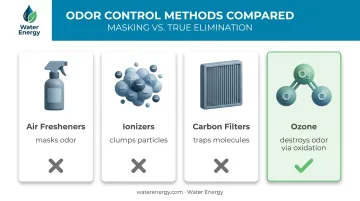
That oxidation process sets ozone apart from other common odor-control methods:
- Air fresheners mask bad odors with a stronger scent instead of eliminating them
- Ionizers charge particles so they clump and settle out of the air, leaving odor molecules untouched
- Carbon filters trap odor molecules physically without changing them, and saturated filters can leach smells back out
Why does ozone still matter next to newer options like hydroxyl generators or HEPA filtration? Reach. Ozone travels as a free gas, or dissolves directly into water, rather than passing through a filter. It penetrates fabric fibers, HVAC ducting, and porous drywall, surfaces a filtration unit never touches.
Ozone shows up in two forms:
- Gaseous ozone – released into air, used for rooms, vehicles, and buildings
- Dissolved ozone – mixed directly into water, used for laundry, water treatment, and food processing
The underlying chemistry is identical in both cases. What changes is delivery and safety control, a distinction that matters once you get into application.
How Does Ozone Remove Odors?
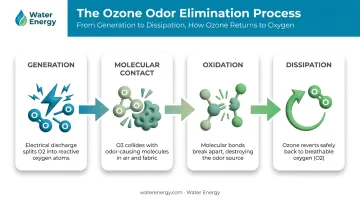
Ozone deodorization isn't a single event. It's a sequence. Four stages determine whether a treatment succeeds or fails: generation, molecular contact, oxidation, and safe dissipation. Skip a step, or shortcut one, and odors survive.
Generation (Initiation)
Ozone generators create O3 one of two ways:
- Corona discharge: a high-voltage electrical charge splits O2 molecules apart; freed oxygen atoms recombine with other O2 molecules to form O3, mirroring lightning in the atmosphere
- UV light: specific ultraviolet wavelengths break apart oxygen molecules the same way, producing ozone without an electrical arc
Generation is machine-driven and continuous while the unit stays powered, whether that's a plug-in air generator in a smoke-damaged room or an inline system feeding dissolved ozone into a washing machine's water line.
The common failure point is undersized equipment. A generator too small for the room, or a cycle that ends too soon, never reaches the concentration needed to react with every odor molecule present. Half the smell gets treated. Half doesn't.
Oxidation (Core Operation)
This is where odor removal actually happens. Ozone's unstable third oxygen atom detaches and bonds to specific odor-causing compounds:
- Phenols in smoke residue
- Amines in pet urine
- Sulfur compounds tied to mold and mildew
That reaction breaks the chemical bonds holding the odor compound together. The molecule gets restructured into simpler byproducts that no longer trigger your olfactory receptors.
Because ozone moves as a free gas or dissolves directly into water, it reaches places standard air purifiers can't: deep into fabric weave, inside duct linings, and through porous carpet backing.
Reaction speed depends on three variables: concentration, exposure time, and humidity. The EPA notes that at concentrations low enough to meet public health standards, ozone often reacts too slowly to fully clear many indoor odor compounds.
Concentrations strong enough to work fast can also be unsafe to breathe. That trade-off is exactly why the next stage matters so much.
Concentration Control & Safety (Regulation)
Ozone doesn't discriminate. It reacts with organic tissue, lungs, eyes, and skin as readily as it reacts with odor molecules. That's why concentration and exposure time need tight control.
OSHA sets the permissible exposure limit for ozone at 0.1 ppm as an 8-hour time-weighted average. Effective odor-elimination levels in air exceed that limit by a wide margin, which is why professional treatments happen in sealed, unoccupied spaces.
The two mediums handle this differently:
- Air treatments require an empty, sealed room and a 12 to 24 hour dissipation window before anyone re-enters
- Dissolved-ozone systems, like those used in laundry, deliver a controlled, low concentration directly into water rather than as breathable gas
Too little ozone and odors survive treatment. Too much, and you risk lung irritation or degraded rubber, elastic, and dyed fabrics. Precision beats raw power here.
Odor-Free Output (Result)
Once oxidation completes, two things happen at once. The odor-causing molecule is permanently altered; it isn't the same compound anymore, so it can't produce the same smell.
The ozone itself reverts to standard oxygen (O2) once the reaction finishes or the gas dissipates.
That's the fundamental difference from masking products. A fragrance spray leaves the original odor molecule fully intact underneath a stronger scent. Once the fragrance fades, the smell returns. With oxidation, there's nothing left to return to.
This is where dissolved ozone earns its place in laundry specifically. Because the reaction happens directly in the wash water instead of in the air, fabrics come out odor-free without a layer of fragrance or detergent residue sitting on top.
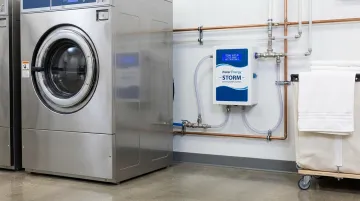
Water Energy's Storm system runs on this exact principle. It injects 0.8 to 1.6 ppm of dissolved ozone straight into the wash cycle, oxidizing odor-causing bacteria and residue in cold water instead of covering them with scent.
Where Is Ozone Odor Removal Used?
Restoration companies lean on gaseous ozone generators for fire, smoke, and water-damage jobs, treating unoccupied buildings after a blaze or a flood to break down the soot and phenol residue that regular cleaning leaves behind.
The IICRC's S700 standard covers this kind of fire and smoke restoration work, though it doesn't prescribe one universal ozone protocol. Treatment time still depends on room size and how deep the odor has penetrated.
Residential and light commercial use follows similar logic on a smaller scale:
- Vehicles with smoke or mildew odor
- Pet areas and litter rooms
- Basements affected by moisture
Each of these needs an empty, ventilated space and a treatment window matched to room size and odor severity. There's no single setting that fits every job.
Laundry and textile treatment sit in a separate category entirely. Instead of releasing ozone into air, these systems dissolve it directly into wash water, oxidizing odor-causing bacteria and residue on fabric as water moves through the machine.
Water Energy's Storm system is built on this dissolved-ozone approach, and it didn't start in a laundry room. The underlying mass transfer process traces back to a 1990s NASA challenge: clean the Space Shuttle's Solid Rocket Boosters and their massive parachutes without generating toxic wastewater.
Engineers developed the Tech2Ozone process to dissolve ozone gas directly into water, hitting the cleanliness level NASA required without adding chemical residue to the water stream.
That same mass transfer technology, refined over 25 years across wastewater treatment, potable water treatment, and commercial laundry, now runs inside the Storm, delivering deodorization on linens using cold water and a fraction of the usual chemicals.
Is Ozone Odor Removal Safe?
Gaseous ozone generators come with a hard rule: unoccupied spaces only. According to the EPA, no federal agency has approved ozone-generating devices for use in rooms with people, pets, or plants present. Inhaling ozone at odor-removal concentrations can irritate lungs and airways.
Dissolved ozone in water sidesteps most of that risk. Because the reaction happens inside water or fabric rather than as airborne gas, there's no breathable ozone cloud to manage. Water Energy's Storm system, for example, delivers a controlled 0.8 to 1.6 ppm dissolved concentration, a dose calibrated for regular residential and light commercial use rather than industrial-strength air treatment.
For air-based ozone treatments, a few practical rules keep things safe:
- Clear the space – remove people, pets, and plants before starting
- Match run time to severity – heavier smoke or mold odor needs longer exposure than a mild pet smell
- Ventilate before re-entry – open windows and doors and let the space air out
- Wait for full dissipation – ozone decays fairly fast indoors, but full clearing still takes time depending on room size and airflow
Your nose isn't a reliable safety gauge, either. The ability to smell ozone can fade during exposure, so the absence of that sharp, metallic scent doesn't necessarily mean the air is clear. That's precisely why professional restoration crews treat and vacate, rather than treat and linger.
Conclusion
Ozone doesn't cover up odors. It takes them apart. Generation produces the O3, oxidation breaks the odor molecule's chemical bonds, and safe dissipation returns everything to plain oxygen. That sequence is why treated smells don't creep back the way they do after a spray or plug-in fades.
The practical takeaway is knowing which delivery method fits your problem. A smoke-damaged room needs a sealed, unoccupied space and gaseous ozone.
A load of towels that won't stop smelling sour needs dissolved ozone working directly in the wash water. NASA used this same principle decades ago to clean rocket parts without toxic runoff, and that mass-transfer process now runs inside systems like Water Energy's Storm. Match the method to the medium, and odors don't just get masked. They get eliminated.
Frequently Asked Questions
Does ozone permanently remove odors?
Yes. Ozone permanently alters the chemical structure of odor-causing molecules through oxidation, so treated odors don't return. New odor sources will still need their own treatment.
How long does it take for the ozone smell to dissipate?
Ozone has a short indoor half-life, often cited around 20 to 30 minutes, and typically clears fully within a few hours. Good ventilation speeds this up considerably.
Is ozone safe to use for odor removal at home?
Gaseous ozone generators require empty, ventilated rooms per EPA guidance since they're not approved for occupied spaces. Dissolved-ozone laundry systems operate at low, controlled concentrations built for regular home use.
Can ozone damage fabrics or other materials?
High concentrations or prolonged exposure can degrade rubber, elastic, and certain dyes over time. That's why laundry systems dissolving ozone into water are calibrated to a controlled ppm range specifically to avoid this.
How is ozone used to remove odors from laundry?
Ozone gets dissolved directly into wash water at a controlled ppm level, oxidizing odor-causing bacteria and residue on fabric. It works in cold water, without heat or harsh chemicals, and cuts drying time too.
What's the difference between ozone and ionizers for odor removal?
Ionizers charge airborne particles so they clump together and settle out of the air; they don't touch the odor molecule itself. Ozone chemically oxidizes and breaks apart the odor-causing compound directly.